Ephesians 5:5

Here is my commentary on Ephesians 5:5. I am publishing these once or twice a week, but you can read all of the available articles at our web-site, http://www.new-life.org.au

Ephesians 5:5

“For of this you can be sure: No immoral, impure, or greedy person – such a man is an idolater- has any inheritance in the kingdom of Christ and of God.”

The warning against sin here is particularly strong. Paul certainly wants us to understand that these sins which may not seem to be so grave as, for example, murder or robbery, they are still subject to God’s wrath .

“For of this you can be sure” means there is no doubt, no equivocation, none of those “ grey areas” which we like to insert into God’s black and white judgements.

No immoral person can inherit God’s Kingdom. Any form of marital infidelity or sexual misconduct is anathema to God. All of the sexual deviations that can be imagined undermine the sacredness of marriage and the stability of families.

The world condones, even celebrates, such sins of the flesh, but God condemns them. They elevate the flesh about the spirit, sensuality over spirituality.

The message of Ephesians is that we are holy people, set apart for God. To be holy means that we must turn away from sexual sin.

Likewise, impure people will not enter the kingdom of God. Impurity suggest a mixture. We want a little bit of the world and a little bit of religion. Impure people like to think they can have Christianity as an added extra to their lives without giving up the pleasures of the world.

God is constantly seeking to refine us or purify us. He is looking for a people who are totally dedicated to Him. He will use any means possible to burn the dross out of our hearts.

Life can be hard, but for christians there is always a purpose in suffering. Often it is the fire of refining.

God cannot stand impurity, half-heartedness, or lukewarmness. This is a state of heart that deceives us into believing that sin is not so big of a deal for the christian. After all God will forgive. But God will only forgive when we can come to repentance, and if we justify our sin we will see no need to repent of it.

A greedy person will also have no part in God’s Kingdom. To be greedy is to be an Idol worshipper. A greedy person trusts in the power of their money or other possessions to keep them safe.

Jesus referred to the god of mammon. There is nothing intrinsically wrong with being wealthy, but when our heart is captivated by money or when our trust or our identity is in our wealth, then we have turned material possessions into a false god.

A greedy person finds it hard to let go of their money, to give to the poor, or to support the mission of the church. Such greed can be fatal as Ananias and Sapphira discovered (see Acts 5). Dependency on money stopped a rich ruler from following the way of Jesus.

The people that are described in this verse have no inheritance in the Kingdom of God and of Christ.

We might think that Paul is saying that these people who have presumably professed faith in Christ will get to heaven, but only by the skin of their teeth. They will have no inheritance so they will be like homeless people on the streets of Heaven.

In 1 Corinthians 3, Paul talks about the things Christians build being tested by fire. He says that some people will enter the Kingdom with nothing of value. However, these are not greedy, impure, or immoral people. They are born again christians who have failed to build anything that is of value in eternity. They were not so much greedy or immoral as misguided or lazy or selfish.

This verse simply restates what is a common theme in scripture. A heart that is truly united to Christ will result in a changed lifestyle and a change of focus.

Do we have to be perfectly sinless to enter God’s Kingdom? No, but we do need to be pursuing God, heeding the Spirit of God, and obedient to the word of God.

Key points in this verse

  • Immorality impurity, and greed are condemned by God
  • Greed is a form of idolatry
  • People who follow these things have no part in God’s Kingdom. They will not enter Heaven
Reflection on Matthew 26:31-44

Scripture

“After I have been raised from the dead, I will go ahead of you to Galilee and meet you there.”

Observation

Jesus tells them that evening they will all desert Him, the Shepherd will be struck, and the flock scattered. At the end of this, God will raise Him from the dead. Peter says that even if everyone else abandons him, he will stay. Jesus says that Peter will deny even knowing Him.

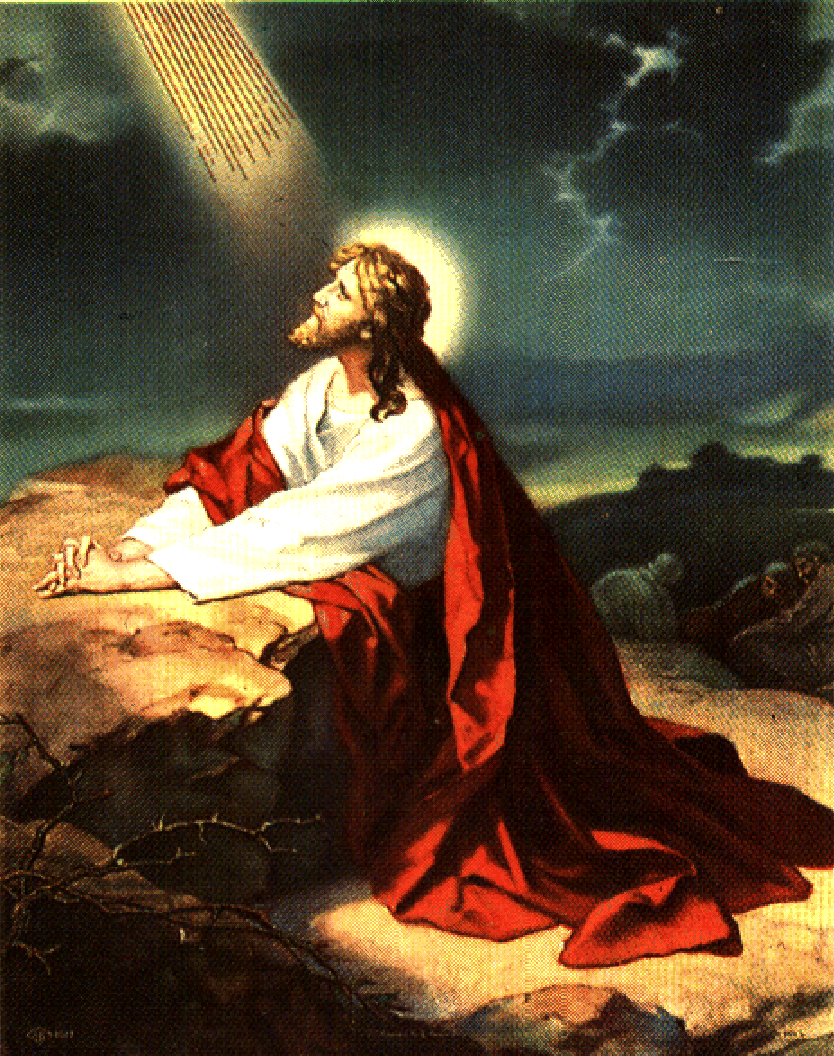
Jesus takes the disciples to Gethsemane, where He asks them to keep watch with Him while He prays. He goes on a little farther and prays to the Father.

He returns to the disciples three times, finding them asleep each time. Finally, He tells them to get up as the betrayer has arrived.

Application

Even at this time of His impending death, Jesus is trying to point his disciples to His resurrection.

This is the Good News for each of us. Every follower of Jesus shares in His resurrection. Death is not the end of the story, but a new beginning, a portal into the new eternal life.

We still have to go through death to get to life, but we will get there.

Jesus endured the cross for the sole purpose of bringing us into right relationship with the Father. He paid the price, and we receive the gift of restoration.

Life on earth is messy, tainted at every level with sin and its consequences. Death is all around us, but it does not have the final word.

We have seen how the story ends. It is life not death, love not war, health not sickness. The victory is His. Hallelujah!

Prayer

Lord God, the victory belongs to you. Thank you for the promise of eternity. I put my trust in you today, knowing that at the last day you will raise me to eternal life. Amen.

Reflection on Matthew 27:17-30

Scripture

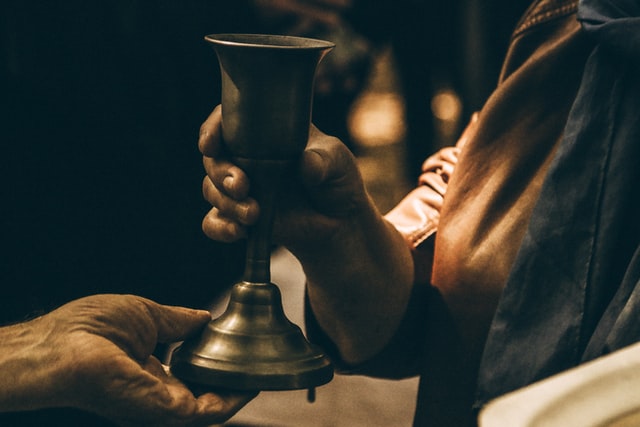
As they were eating, Jesus took some bread and blessed it. Then he broke it in pieces and gave it to his disciples saying, “Take this and eat, for this is my body.” And he took a cup of wine and gave thanks to God for it. He gave it to them and said, “Each of you drink from it, for this is my blood, which confirms the covenant between God and his people. It is poured out as a sacrifice to forgive the sins of many”

Observation

Jesus and His disciples celebrate the Passover. While they are eating the Passover meal, Jesus tells them one of them will betray Him. Each one asks if it is them, but Jesus indicates it will be Judas.

As they are eating, Jesus takes the bread and says, “This is my Body.” Then He takes the cup of wine and says, “This is my Blood.”

At the end of the meal, they sing a hymn and go to the Mount of Olives.

Application

Jesus takes the centuries old Passover celebration and applies it to Himself. He is the Passover Lamb, the one who takes away the sins of the world. He is the one who sets His people free from the bondage of sin and into the freedom of God- centred life.

Every week, our church celebrates Communion. We pause for a few minutes and put Jesus’ death on the cross right at the forefront of our thinking. Whatever we do in the rest of he service, and whatever happens in the rest of the week, it all revolves around the death of Jesus on the cross.

Prayer

Thank you Lord Jesus for dying for me and paying the price for my sins. As you gave your life for me, I give my life to you. Amen.

Ephesians 5:4

Here is my commentary on Ephesians 5:4. I am publishing these once or twice a week, but you can read all of the available articles at our web-site, http://www.new-life.org.au

Ephesians 5:4

“Nor should there be obscenity, foolish talk, or coarse joking which are out of place, but rather thanksgiving.”

Paul now turns to the specific speech which should mark the conduct of christians.

In our current culture, we have a very low standard for speech, both in private and public settings. It is not uncommon to hear people shouting words which are generation ago were considered obscene and unsuitable for public utterance.

Political and community leaders have been heard using expletives when they mistakenly thought the microphones were turned off.

Even in church meetings, words which 10 or 20 years ago would have raised eyebrows are spoken without any discomfort.

We have freed up epithets related to sex (although a new form of secular puritanical censorship is emerging that says a new set of words are unacceptable) and banned racial descriptions.

The people of God and not controlled by legalism or political correctness. We are, however, to let our speech be directed by a sense of what is “ fitting” or appropriate for the holy saints of God.

Paul says certain forms of speech are “ out of place.” These things are not sinful or morally wrong. They are simply not suitable given our position in God’s Kingdom.

We do not have a list of words that must not be spoken, as these vary from place to place, culture to culture, time to time. Instead, we need to ensure that our thoughts and the words we speak out loud are led by the Holy Spirit.

The word obscenity here refers to speech that would make a morally sensitive person ashamed. Earlier Paul said that some things should not even be mentioned amongst them.

It is hard to pin down what might be intended here without indulging in the thing being forbidden. It could be assumed that various sexual deviances and practices might be included.

This is not to say that Paul is prohibiting discussion of homosexuality, for example. It is important to say that certain activities are not permissible. Where we might cross the line is where we indulge in too much detail or idle speculation .

“Foolish talk” is the sort of meaningless rubbish that a drunken person might babble.

A lot of social banter might come under this category. A little humour might be considered suitable for breaking ice and oiling social interactions. However if our conversation is limited to reciting Monty Python’s “Dead Parrot” sketch then the Holy Spirit may be lacking.

Instead of merely allowing conversation to remain at a shallow surface level, we should allow our interactions to be used for mutual edification, encouragement, and exhortation.

“Coarse joking” is a form of humour which derives amusement at the expense of others. We might think initially of sexual humour, but it includes every form of jesting which puts people down.

The point is that we are meant to be honouring people who are made in the image of God and for whom Christ died. How do we derive laughter at the cost of any person?

Instead of these forms of speech which Paul says are “ not suitable,” we should practice thankfulness.

Everything we have is a gift from the Lord. “Every good gift comes from above,” James tells us.

Any fool can tell a dirty joke or engage in meaningless twaddle. The person of faith will seek to elevate his or her thinking and speaking in order to honour God in all things. In 1Thessalonians 5:16-18, Paul tells us to “ rejoice always, pray constantly, and give thanks in all circumstances, for this is the will of God in Christ Jesus for you.”

It is God’s will that we learn to rejoice and give thanks in all circumstances. Whereas the unsaved cannot see a reason for what happens in life, the christian can always see God’s hand in their lives and find reasons to give thanks.

This is not a wilful denial of pain and suffering in life. Rather it is a contentment and celebration that in all things God is with us.

Key points in this verse:

  • Some forms of speech and not suitable for the people of God
  • We need to build up others with our words, not tear them down
  • We should make thanksgiving a feature of our speech

Reflection on Matthew 26:1-16

Scripture

“You will always have the poor with you, but you will not always have me.”

Observation

Jesus warns His disciples that He will shortly be handed over to be crucified. At the same time, the leading priests and elders are meeting together to plot how they will capture Jesus and kill Him.

While Jesus is at the home of a man called Simon in Bethany, a woman comes in carrying an alabaster jar of perfume. She pours it over Jesus’ head. The disciples grumble about how the perfume could have been sold and the money given to the poor.

Jesus asks them why they are criticising her for doing a good thing for Him. The poor will always be with them, but she has poured out love for Jesus.

After this, Judas goes to the priests and agrees on a price to betray Jesus.

Application

In this short passage, we see some divergent attitudes to money and wealth.

Judas seems to have been interested in money for its own sake, as are many in the world today.

The unnamed woman used her wealth to pour out love and adoration on Jesus.

The disciples think that this money should have been used for something practical rather than “wasted” on Jesus.

The important thing underlying these reactions is the heart attitude towards Jesus. Sometimes we get lost in the need to keep the money coming in for our own needs or for our ministry, or we may forget that our primary mission os to honour Jesus, not to feed the hungry.

Christians can be critical of others for spending money on projects that they do not approve of. Why “waster” money on a building or a basketball court, when it could be used for what I think its important?

If somebody chooses to give money for a building project or a new car for their pastor, if they are doing it from a genuine love for the Lord, who am I to criticise?

Prayer

Lord, please give me grace to rejoice in every expression of worship and adoration of you. Amen.

Ephesians 5:3

Here is my commentary on Ephesians 5:3. I am publishing these once or twice a week, but you can read all of the available articles at our web-site, http://www.new-life.org.au

Ephesians 5:3

“But among you there must not be even a hint of sexual immorality or of any kind of impurity or of greed, because these are improper for God’s holy people.”

A more literal translation of this verse is: “ But fornication, and all impurity or covetousness must not even be named among you, as is fitting among the saints.” (NRSV)

These things, according to Paul, should be so far from our normal thinking that we who are the holy ones of God should not want to even mention them, much less commit them.

It’s might be asked, how can we avoid thinking about sexual immorality, impurity, and greed, when these are rife in our society. Well, they were common enough in the Roman Empire as well. The lusts of the flesh have always and In most places been a stumbling block for Christians.

At the very least, we should make sure that we live a life worthy of our high calling as children of God, putting Jesus first in all things.

We should review our entertainment sources. So many forms of entertainment normalise attitudes of sexuality and greed which are opposed to the holiness of God.

We should monitor our conversations and ensure that our speech does not revolve around sex or desires for new cars, faster computers, and better houses in better neighbourhoods. These are not things that should be at the centre of our thoughts and discussions.

Sexual immorality or fornication refers to the undermining of marriage. Men and women are meant to be faithful to their partners for life. The traditional marriage vows speak of “ forsaking all others for as long as you both shall live.”

Our society glamorises infidelity. Having an affair, hooking up, a bit on the side, booty call, are common terms which denote a generally permissive attitude to sex beyond marriage. Marriage is often seen as confining, boring, and suffocating. Seeing someone else can be liberating, refreshing, exciting.

On the contrary, Paul will, later in this chapter, describe marriage as being a representation of Christ’s relationship with the church. It is impossible to conceive of Christ abandoning the church to have a different covenant with a different group of people. This goes against His nature. Similarly, sexual immorality goes against the nature of God’s holy people, the saints.

The phrase “any kind of impurity” takes the standard further. Here it is not just about unfaithfulness in marriage, but any kind of sexual desire or practice which lies outside of the covenant of marriage.

We might throw into this category such things as pornography, sexualised banter, double-entendre, homosexual acts, prostitution, and much more.

The church is meant to be pure and holy, and a representation of the original pre-Fall state of Adam and Eve.

Our aim should be to pursue Christ, and when we pursue these other things, we miss the mark of our holy calling.

The word covetousness implies a ruthless kind of greed that tramples over the rights of other people in order to gain what is wanted. The classic cases of this in scripture King David’s desire for Bathsheba (2 Samuel chapters 11-12) and Ahab’s desire for Naboth’s vineyard (1 Kings chapter 21). In both cases, covetousness leads to unforeseen consequences, escalating quickly to murder.

The original sin in Genesis was to covet something that God had forbidden. “When the woman saw that the tree was good for food, and that it was a delight to the eyes, and that the tree was to be desired to make one wise, she took of its fruit and ate.” (Genesis 3:6, NRSV)

These things (sexual immorality, impurity, and covetousness) are not fitting the God’s holy people. They relate to the fleshly nature, the old nature which is supposed to be crucified when we come to Christ.

We should not approach these things from a legalistic point of view, laying down laws in a new form of Pharisaism. The solution is not to “mortify the flesh”, but to look to Christ. As we gain a more perfect and exalted vision of Jesus, and make pursuing Him our prime objective then all of these desires will just fade away.


Key points in this verse:

  • There are some things which Christians should be careful in talking about in their gatherings
  • Sexual immorality, impurity, and covetousness should become removed from our thoughts
  • We need to monitor our own speech, our entertainment, and our desires to ensure that we are not pursuing the desires of the flesh
  • The solution does not lie in legalism, but in putting Jesus Christ at the centre of our thoughts and desires

Reflection on Matthew 25:31-46

Scripture

“And the King will say, “I tell you the truth, when you did it for one of the least of these my brothers and sisters, then you were doing it for me!”

Observation

Jesus will sit on His throne in glory, and all the people of the earth will stand before Him. He will separate the people into two groups like a shepherd sorts his sheep from his goats.

Those on His right, the sheep, He will commend for their good works, for the deeds of service and kindness done to Jesus. They will profess ignorance of how they did this, but Jesus says that whatever they did for the least of His brothers and sisters they did for Him.

Similarly, the goats will be condemned for their negligence towards Jesus. They are also told that when they neglected the least of Jesus’ brothers and sisters they neglected Him.

Those who are declared unrighteous will go to eternal punishment, but those who are righteous will enter eternal life.

Application

Our attitude towards Jesus is shown by our attitude to the least of His brothers and sisters.

Some people say that for this reason we must serve everybody in order to serve Christ. This is not what is being described here. The brothers and sisters of Christ are His disciples. Together we are the Body of Christ, and so when a part is suffering, the true disciples will seek to reduce the pain of even the least important member.

If I claim to be a christian and remain indifferent to the suffering of the brothers and sisters of Christ, then my actions show that my words are incorrect.

Different people have different God-directed ways of expressing this. Some are passionate about orphans in Africa; some are directed toward prison ministry; still others to helping church members who are sick or permanently disabled.

Faith must be expressed in service, for servanthood is the pathway to greatness in the Kingdom of God.

Prayer

Lord, please help me to always be sensitive to the needs of my brothers and sisters in Christ. Amen.

Reflection on Matthew 25:14-30

Scripture

“To those who use well what they are given even more will be given, and they will have an abundance. But from those who do nothing, even what little they have will be taken away.”

Observation

The kingdom of heaven is like a man going on a long trip. He gives five bags of silver to one servant, three to another, and just one bag of silver to another. The first two servants work hard and invest the master’s money to double it. The third servant buries the master’s money in the ground.

The master returns, and the first two servants present him with his money which they have doubled. The third servant returns the original amount of money to the master.

The master commends the two servants and gives them more responsibility. The money is taken from the hapless third servant and given to the first one. The third servant is cast out of the household.

Application

We are used to seeing this parable in terms of our gifts and talents. But really it applies to every part of our lives- our time, money, abilities, opportunities, and so on.

Our whole life is to be dedicated to the Lord. Everything we have comes from Him, and belongs to Him.

Like the servant in the story, we do not own what has been given to us. We are managers on God’s behalf.

The issue is not whether I have a lot to offer to God. It is all about my desire to honour Him with what I do have.

Prayer

Lord, with you in the first place, there is no second place. Everything is subject to you. May my choices and my desires glorify your name. Amen.

Reflection on Matthew 2:1-13

Scripture

“Later when the other five bridesmaids returned, they stood outside, calling ‘Lord! Lord! Open the door for us!’ But he called back, ‘Believe me, I don’t know you!’”

Observation

The Kingdom of heaven, Jesus tells us, is like ten bridesmaids waiting for the groom. Five were wise and took extra oil for their lamps, but five were foolish and did not take enough oil.

The bridegroom is delayed. When he arrives, late at night, the five foolish girls find they have run out of oil.

While the foolish bridesmaid are away buying oil, the bridegroom comes and takes the wise girls to the wedding feast. The foolish girls finally arrive, but they find the door is locked and they are not allowed in.

Application

This parable seems harsh, but the message is clear; if we are not ready, we will not be allowed to enter into the kingdom.

The sin of the foolish bridesmaids is that they were not ready for the bridegroom. They thought they had enough oil, but had not factored in a delay. Their own preparations were inadequate.

Many people think that their good deeds or occasional religious observances will get them there. They think that they are good enough for God.

We can never be good enough for God if that is the standard we want to be judged by.

The foolish bridesmaids should have known the bridegroom better. The wise ones made provision for the fact that the groom would be delayed. They knew him, and they knew he would stop to chat with his family and old school friends along the way. They were ready for the inevitable.

To enter God’s kingdom we have to know Jesus, the bridegroom. Your destiny does not depend on how good you are or how knowledgeable. You must know Jesus.

Prayer

Thank you Jesus for the gift of eternal life that comes from you. Amen.

Ephesians 5:2

Here is my commentary on Ephesians 5:2. I am publishing these once or twice a week, but you can read all of the available articles at our web-site, http://www.new-life.org.au

Ephesians 5:2

“And walk in love, as Christ loved us and gave Himself up for us, a fragrant offering and sacrifice to God.”

We are to walk in love as Christ loved us. The Christian life is not a series of negatives which constrain our behaviour with boundaries of what we are not permitted to do.

The overarching command is to love God, to love our neighbours, even to love our enemies.

Paul encourages us here to make love such a part of our ethical system that it becomes the focus of our walk along the road of life. We are to walk in love footstep by footstep, day by day, loving those whom we meet.

When we practise love, what is a difficult concept at first becomes a part of our lives. This is not to suggest that love ever becomes mechanical, but the habit of concentrating on others becomes automatic.

This love again is God’s love, the love of Christ or agape love. Christ’s love is unfailing, eternal, and unchanging just as God is unfailing, eternal and unchanging.

In Christ we see how love is acted out at the human level. Christ gave Himself up for us .

Firstly Christ gave Himself up when He left the glorious throne in heaven and became a human being. He took on weakness and the various limitations of being in a body. He was subject to all the appetites of the flesh and also its demands.

Christ gave Himself up by subjecting Himself to the Jewish law, the law of Moses. He who was without sin still had to offer the various sacrifices that were ordained to reconcile sinful people to a holy God.

Christ gave Himself up by humbling Himself under the authority of religious and civil leaders. He was so much greater than they were, yet he obeyed them .

Finally, Christ gave Himself up at the cross. He was beaten, mocked, tortured, and nailed to a cross. Crucifixion was not only an intensely painful way to die, it was a shameful punishment. It was so shameful, in fact, that Roman citizens were not permitted to be crucified.

Christ gave up His divine right to be above such suffering. He gave up any human right to be vindicated and set free, despite the obviously fabricated charges brought against Him.

On the cross, Jesus bore the brunt of the Father’s wrath against sin. This was infinitely greater than the common suffering of all who were punished by crucifixion. The divine Son of God who had known an eternity of intimacy with the Father now found Himself forsaken by God.

Christ carried the burden of every sin committed, every offence against God’s righteousness, since the time of Adam, stretching to our own time and beyond. He suffered the eternity of Hell in six hours on the cross.

Christ gave Himself up to suffer on our behalf. He suffered physically, emotionally, and spiritually.

In His suffering He became a fragrant offering and a sacrifice.

In the Temple, and before that the Tabernacle, there was an altar where fragrant incense was offered continually to the Lord. The smoke from this incense was considered to be pleasing to the Lord.

So Paul tells us that Christ’s death on the cross was a fragrant offering, similar to the smell of incense wafting up to heaven.

Incense is not of itself pleasing to God. A stick of incense is just a stick. It is only when it is burnt that the incense is released. In a sense, the incense must die to release the fragrant offering that pleases the Lord.

In a similar way, the death of Christ released a fragrant offering to the Father. This offering was the reconciliation sinful humanity to the holy God. The achievement of that purpose, which stretched back even before creation, pleased God.

Christ’s death was more than a pleasant smell. It was a sacrifice. Sacrifices achieve various things in the Old Covenant, but the most important of them is atonement.

Atonement means that the death of an animal is accepted on my behalf as payment for my sin. I deserve to die for dishonouring God, but he chooses to accept an animal’s death instead.

The Old Testament describes very detailed procedures for the type of sacrifices required for various sins, as well as the method of slaughter for the animal.

The principle is simple- one sin equals one sacrifice.

Then on the Day of Atonement the sins of the whole nation were laid on the head of a goat which was driven into the wilderness.

Over and over, and in many different ways, the Lord impressed on his people the gravity of sin and their need to be made right with Him.

Now Jesus who is over and above any created being, has been offered as an atonement, the sacrifice, for our sin. He is the Lamb who takes away the sins of the world.

Every sin of every person who ever lived, and who will ever live, has been put to death with Christ on the cross.

He died so that we can live. Because of Christ’s sacrifice my sins are forgiven. I am justified and made holy so that I can enter the presence of God for ever.

We were headed for hell with no hope of rescue, but Christ died and set us on the pathway to Heaven, where we will live with God forever.

This is how much God loves us. He sent his one and only Son to be our sacrifice and our fragrant offering. Because God loves us so much, we two must walk in the love of Christ.

Key points in this verse:

  • Walking in Christ’s love prevents us from viewing the Christian life as just a set of rules
  • Love can become a way of life when we practise Christ’s love
  • Christ gave Himself up for us in His birth, in His life, and above all in His death
  • Christ’s death is a fragrant offering pleasing to the father
  • Christ’s death is a sacrifice which atones or pays for our sins for eternity