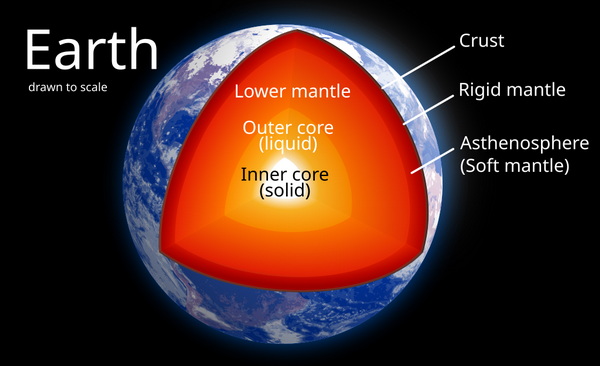
Earth’s Inner Core “Fine Tuned” for Life

The more we find out about the earth, the more it is clear that it is very cleverly designed for the purpose of supporting life.

From Creation Evolution Headlines:

Earth’s Core Is Fine-Tuned for Surface Habitability

New simulations of the Earth’s core
indicate extremely precise conditions
for its formation, exposing flaws in
cosmological evolutionary theory

Magnetic Miracles
Earth’s Inner Core and the Glory of God

by Sarah Buckland-Reynolds, PhD

A landmark study by four UK scientists, published this month in Nature Communications, unveils yet another striking geoscience discovery that points to fine-tuned design and challenges long-held evolutionary assumptions.

Constraining Earth’s core composition from inner core nucleation (Wilson et al, Nature Communications, 4 Sept 2025).

As it turns out, this latest example of fine-tuned design was beneath our feet all along: within the Earth’s inner core.

The Research

Researchers, Wilson et al from the University of Oxford, Leeds, and University College London, simulated the conditions required for Earth’s solid inner core to form, resulting in it’s present structure, temperature and magnetism. After testing numerous combinations of elements, the team found that core nucleation and crystallization would only occur with precisely 3.8% carbon in its makeup; otherwise, Earth’s core would have remained molten.

Comparative simulations showed that no other elemental mix could sustain a stable magnetic field, leaving the planet vulnerable to solar wind and charged particles—potentially even stripping away its atmosphere. Despite beginning from evolutionary assumptions of an initially molten core—and acknowledging unaccounted complexities—Wilson et al.’s research nonetheless points powerfully to fine-tuned design and raises fresh challenges to long-standing evolutionary views on Earth’s core formation.

The Core of the Matter: Functionality Beyond the Depths

Research into the Earth’s core is highly relevant, as the role of its size, state and composition is known to directly impact Earth’s habitability. Research on Earth’s core is vital, since its size, state, and composition directly affect the planet’s habitability. Earth’s magnetic field—essential for preserving the atmosphere, deflecting harmful solar wind, and guiding migratory species—depends on the core’s composition, which drives convection in the outer core.

According to cosmological evolutionary theory, Earth’s core began in a molten state, due to radioactive heating. Yet for the inner core to crystallize, a precise mechanism was required. To address this, the researchers drew on seismology and melting-point data, which indicate that the core is less dense than pure iron. This suggested that Earth’s present magnetic strength depends on a mixture of elements.  The authors acknowledged, however, that multiple possible combinations remain consistent with traditional constraints, leaving some ambiguity.] However, their research found that of all simulated possibilities, only a 3.8% carbon composition (with a supercooling temperature of 266K) could account for the processes of nucleation and the estimated present size of the Earth’s core.

Even without challenging the unobservable assumption of an initially molten core, this article demonstrates that the very existence of the solid inner core requires a finely tuned chemical composition for today’s geophysical processes to function. Although the Scriptures are not clear about the solid vs. molten state of the Earth’s core at creation, this discovery shows that a precise composition of the core would have been necessary to give rise to the magnetic properties of Earth that life relies on. In an evolutionary framework, the question arises: How did nature “know” the amount of each element required for the core to produce the thermal profile necessary for Earth’s magnetism?

Read the rest of the article here

The Challenge of Iron For Life

An amazing article about iron- both essential to life and toxic, sequestered in the core of the Earth, but needed at the surface

From crev.info

How Iron Fortifies the Earth and Life – CEH

2 minutes


March 29, 2025 | David F. Coppedge

This article about the element iron
and its design was published in
Evolution News on 25 Jan 2022


No Iron, No Life: Intelligent Design in Iron Availability

by David F. Coppedge
January 25, 2022

As an exercise, count the number of lucky breaks that had to occur for the evolutionary story to work.

Life relies on iron, but it is toxic, too. And it’s hard to get this scarce resource where it’s needed. Here is another case of fine-tuning that adds to the many Goldilocks “just right” conditions for life on our planet.

The Biophysics of Iron

Evolution News has reported on the gentle handling of iron by enzymes in cells, such as this discussion by Dr. Howard Glicksman, in which he describes the delicate interplay of iron and oxygen in hemoglobin that makes our blood red. He tells how specialized enzymes control acquisition, transport, and control of iron. Indeed, the building blocks of hemoglobin that incorporate iron, called heme molecules, are toxic within cells and also must be carefully handled, as this article relates.

Just how carefully can be seen in two animations of the CcsBA enzyme from research at Washington University at St. Louis. The enzyme molds itself around a heme (pictured green, with an orange iron atom at its center), preparing and assembling it for transport. It took the research team three decades to figure this out, and this is just the bacterial version!

As fascinating as these irreducibly complex systems are individually, they assume that iron will be available in the environment. How did that happen?

The Geophysics of Iron

Iron availability on the earth must be finely tuned. Iron in the Earth’s core, though abundant, will not be of any help to plant life on the surface or to ocean life. We observe that iron is abundant in crustal minerals, as seen in the colorful iron oxides that bestow reddish colors on many desert walls (and the planet Mars). Iron is also abundant in olivine, which can be delivered from the mantle by volcanoes. In a recent articleEvolution News described how “meteoric dust” from the solar system can gently rain iron onto the oceans for photosynthetic microbes like diatoms to use. But how did iron become finely tuned as to quantity and availability?

To continue reading, click here.

Darwin’s Blunder Lives On

From Creation Evolution Headlines

David F. Coppedge writes

Darwin’s Blunder Lives On

A major journal publishes a paper
claiming that natural selection is
like human engineering

Darwin’s blunder was criticised by scientists in his own day. He likened natural selection to artificial selection: i.e., human breeding of plants and animals. The two concepts could not be farther apart. They are opposites. Now, three guys print the same blunder out in the open with shameless bravado.

Weinberg’s Law: an expert is a person who avoids the small errors while sweeping on to the grand fallacy.

What farmers and ranchers do as they try to produce better tomatoes or stronger horses has nothing to do with Darwin’s theory. Breeders have foresight. They have intentionality. They set a goal, and can gauge the success of their efforts by measurable results. Darwin’s Stuff Happens Law has none of the above.

Charley specifically denounced any role for foresight, intentionality, or purpose in the operation of natural selection (NS). NS was to be a blind, unguided mechanical process all the way down. Darwin’s own “intention” was to rid biology of any role for a Creator God or designer of any kind. And yet he repeatedly used a fallacious argument from analogy for support, claiming that natural selection is like artificial selection. He was still claiming this in 1876 in the 6th edition of Origin of Species, 17 years after the 1st edition.

Slow though the process of selection may be, if feeble man can do much by artificial selection, I can see no limit to the amount of change, to the beauty and complexity of the coadaptations between all organic beings, one with another and with their physical conditions of life, which may have been effected in the long course of time through nature’s power of selection, that is by the survival of the fittest. [Origin, 6th ed., ch. 4, p85]

Ah, the fittest. Yes, that was the purpose of the blind watchmaker: increasing an organism’s “fitness” (whatever that is). Please re-read our entry, “Fitness for Dummies” to recall that fitness is a slippery, undefinable tautological term that can mean anything the evolutionist wants it to mean. But why would a blind process even know or care about the definition of fitness? Stuff Happens; that’s fitness in a nutshell. Anyone who stuffs that idea into his skull has it in a nut shell.

Darwin never saw his own fallacy. He should have known better, having been a pigeon fancier and a friend of breeders. He should have known that the outlandish varieties produced by breeders, like poodles and dachshunds and pouter pigeons would never have arisen naturally—indeed, they could not survive in the wild. But Charley reasoned that if breeders could accentuate small variations to those extremes, couldn’t Nature accomplish much more, given millions of years? “I can see no limit,” he said. That’s because his eyes were closed, and he was daydreaming in his imagination.

Summing up, Darwin thought (illogically) that if human intelligence can accentuate variations for a purpose, why couldn’t blind nature accentuate variations for no purpose at all? He reasoned that Nature is just like a thinking, rational breeder, that purpose is just like chance, that foresight is like blindness, and that intention is like aimlessness.

He didn’t get it. In his new book Darwin’s Bluff, Robert Shedinger quotes from Darwin’s own correspondence how he persisted in this fallacy to his dying day.

Darwin’s disciples today still sweep on to the same grand fallacy. Here is a spectacular example printed by Nature yesterday.

Engineering is evolution: a perspective on design processes to engineer biology (Nature Communications, 29 April 2024). These three Darwinians (Simeon D. Castle, Michiel Stock and and Thomas E. Gorochowski) do a one-up on Darwin. Not only is evolution like breeding, they assert; it’s like engineering! Indeed, they say, engineering is evolution! The paper is open access, so go ahead: watch them sweep on to the grand fallacy.

Read the rest of the article here

Apollo Astronaut Doubts Consensus Age of Moon

How Old Is The Moon?

From Creation Evolution Headlines

It started when he was told the same
moon rock had two vastly different ages

How old is the moon? Is it 4.6 billion years old, as consensus geologists insist, and as textbooks uncritically teach?

The Apollo astronauts were given extensive training in geology so that they would know what rocks on the moon were significant. This was true for Brigadier General Charles M. Duke (USAF), the Lunar Module Pilot on Apollo 16 who became the 10th man to walk on the moon. One of his geology trainers was Harrison Schmitt, a PhD geologist, who would fly on the final mission, Apollo 17 (see 14 Dec 2022). Apollo 16 (April 16-27, 1972) was the only mission to study the lunar highlands in the Descartes region, with its elevation 7,400 feet higher than the Sea of Tranquillity explored by Apollo 11. (Charlie Duke was also the CapCom, or capsule communicator, for Apollo 11.)

During their three extensive extra-vehicular activities (EVAs), including 16.6 miles of drives on the lunar rover, Charlie Duke and Mission Commander John Young collected 209 pounds of lunar samples.

Moonrock, by Alan Bean, depicts John Young and Charlie Duke (Apollo 16) collecting lunar samples. Used by permission from Alan Bean (Apollo 12 astronaut).

On April 6, during an interview before an audience of nearly a thousand people, Duke related a strange thing that the experts said about one of the lunar rocks he collected.

I picked up a rock on the moon, and it was about the size of my hand. And on one end it dated 3.9 billion years. On this end it dated 1.6 billion years. So there was two billion years between six inches! [audience laughter]. And, something was wrong here, somewhere!

Duke went on to say that he “began to doubt a little bit,” but not to the point of disbelieving evolution. At the time, he was a non-Christian, thoroughly preoccupied with his own career success within the NASA community. It was only later, when he became a Christ follower after seeing the dramatic change in his wife Dotty’s conversion, that his earlier doubts about that rock made sense. “I became a believer, and I went from an evolutionist to a creationist.”

At age 88, Charlie Duke is the youngest of four surviving Apollo astronauts among the 12 men who walked on the moon. Another Apollo astronaut who was a young-earth creationist and Christ follower was Apollo 15 astronaut James Irwin (1930-1991).

Creation Or Evolution

I have been thinking this week about two stories of how we arrived in the world. The first theory is evolution, which says that we are just a product of random chemical reactions over a very long period of time. The second story is that of creation as described in the very first chapter of Genesis.

This is not the place to say whether one of these stories is factually correct, or whether we can blend the two together in some way. I do want to consider some of the ramifications of these stories and the results of believing one or the other.

As we read the familiar words of Genesis 1, we discover that God is greater than the world, the sun and moon, the stars and bigger than everything all put together. Science tells us that the universe is unimaginably huge and more complex than we can imagine, but God is bigger than all of this.

At each stage of the process, God describes the creation as good, until the last day when He makes the first people and He describes it as “very good.” It is as if everything is made for the purpose of supporting human beings.

The Bible teaches that we are created for a purpose and that we are the pinnacle of God’s creative activity.

On the other hand, evolution tells us that everything is random, from the birth of our planet (an insignificant lump of rock on the edge of an average galaxy), to the production of individual human beings (you are just a random arrangement of DNA, and it determines your life).

So we get to a place of despair because there is no reason for us to exist. There is no future because in the end the whole universe will just run out of energy.

From that depressing explanation of life, we reap a harvest of depression, purposelessness, sexual anarchy and lawlessness.

God made you for a purpose. He has a plan for your life and a destiny for you in eternity.

Praise God!

Creation.com:What’s a billion years between friends?

by 

Published: 9 December 2021 (GMT+10)
commons.wikimedia.orgstar

The extinction of the dinosaurs is typically said to have been about 65 million years ago (mya),1 but 66 mya has also been suggested.2 During my dinosaur presentations I inform the audience, but I don’t amend my slides. After all, what’s a million years (in this case around 1.5 %)?!

In other public talks, I discuss the big bang timeline, starting ~13.8 billion years ago. This is more than one billion years off from the age of the universe taught in the mid-nineteen nineties, of some 15 billion years (actually 8%).3 But what’s a billion years?!

The Bible’s timeline is unchanging (e.g. 1 Peter 1:25), like its Author; ‘Jesus Christ is the same yesterday and today and forever’ (Hebrews 13:8). The word of God reliably teaches a creation around 4,000 BC. Therefore, building your worldview on Scripture is a sure thing—your source does not keep changing. Not so with an evolutionary view, where new discoveries often seem to throw the prevailing (long age) view, for the timing of this or that aspect of history, under the proverbial bus. No need to worry though, for adherents can simply alter some previously believed interpretations in order to keep the narrative alive. Three recent examples of this are given below.

1. How can a star be older than the universe?

A spanner has been thrown in the works for those who believe the universe is 13.8 billion years old. Why? Apparently there are stars over 14 billion years old. You might wonder, “If the universe is 13.8 billion years old, how can a star be more than 14 billion years old?”4


Click here to read the rest of this article

Bit of a problem with the time line (yet again)

Ken Kam writes:

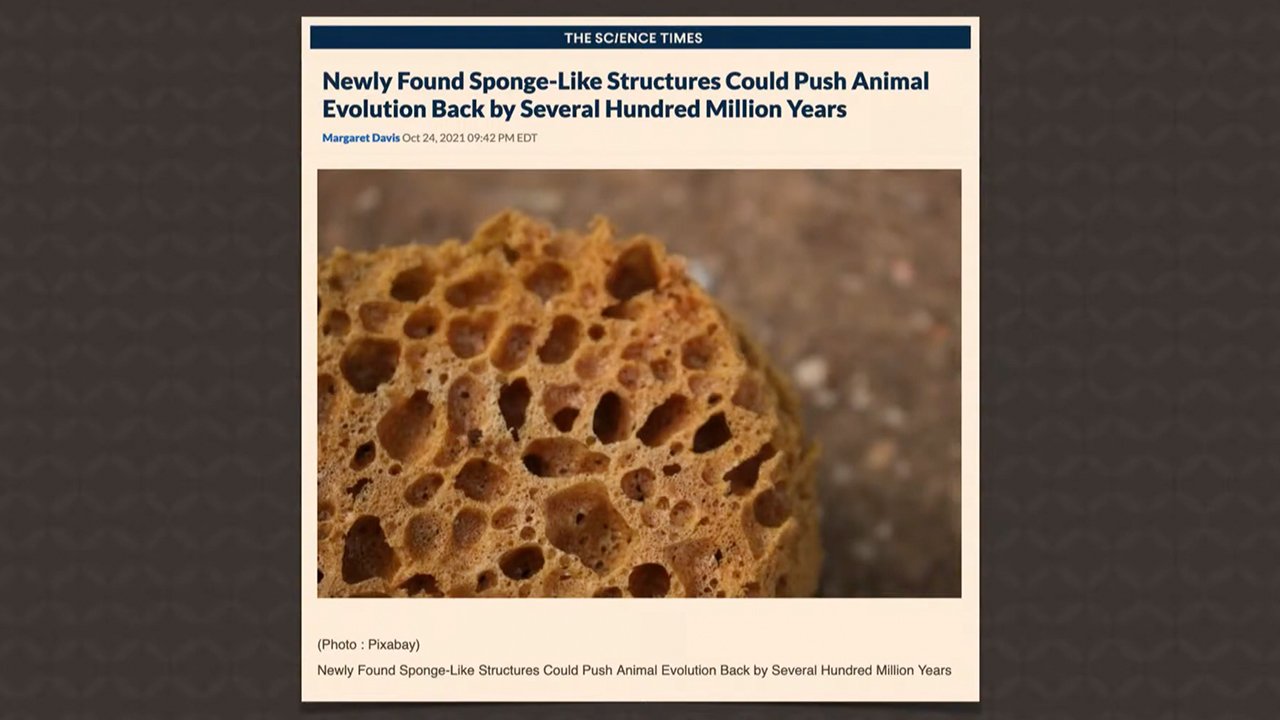
Animal Evolution Pushed Back Hundreds of Millions of Years

New sponge pushes back the “settled science” on evolution but doesn’t change the biblical narrative—since people didn’t evolve from sponges.

by Ken Ham on November 12, 2021Featured in Ken Ham

“Newly discovered sponge-like animals could change the known history of animal evolution.” Claims like this are ones we often hear—the evolutionary story and timeline are constantly changing as new finds upset everything they thought they knew, such as when animals first evolved from sponges (if they even evolved from sponges—that’s much debated in the evolutionary community!).

Now, some will claim this is just how science works. After all, our knowledge about the natural world adjusts as we make new discoveries. But it’s interesting to note how frequently this happens with the idea of evolution—timelines that were “settled science” or “undebatable” are suddenly changed by hundreds of millions of years (no small amount of imaginary time!), and now everything must change in light of the new interpretation of the evidence. It seems stories about such changes are now happening weekly! Why is the story changing so frequently?

The reason evolutionary ideas are constantly in flux, with “settled science” being overturned constantly, is that millions of years/evolution is the wrong worldview and the wrong starting point.

Well, because animals didn’t evolve from sponges (or anything else!) in the first place. The reason evolutionary ideas are constantly in flux, with “settled science” being overturned constantly, is that millions of years/evolution is the wrong worldview and the wrong starting point. It relies on the faulty interpretations of people who weren’t there, who don’t know everything, who frequently make mistakes, and who are attempting to explain the origin of the universe and all life apart from the eyewitness account God has given us in his Word! Wrong starting points mean wrong conclusions regarding the data.

When we start with God’s Word, we have an unchanging basis on which to ground our thinking. Only then can we properly understand the world around us and develop models and hypotheses that are consistent with both the evidence and the eyewitness of all history.

Read the full article here

Creation Ministries: Snakes v. Cane Toads

A good article from Creation Ministries about why snakes adapting to cane toads is natural selection not evolution

Do toads goad snake evolution?

by David Catchpoole

First published: 27 April 2006 (GMT+10)
Re-featured on homepage: 10 March 2021 (GMT+10)
toad

When leading public institutions repeatedly broadcast as fact that ‘we see evolution happening today’,1 it’s not surprising that many people believe it.

One example is a recent prime-time breakfast radio segment on Australia’s national broadcaster, ABC Radio National. The University of Sydney’s Professor Richard Shine told the presenter Fran Kelly that he and his co-researchers studying snakes have observed ‘genuine evolutionary changes’.2

What were they? Allegedly snakes are evolving to cope with the spread of cane toads across the Australian continent. (Cane toads were introduced to north Queensland in the 1930s, and have steadily expanded their range, moving south into New South Wales and west into the Northern Territory.) The changes are making snakes ‘much less vulnerable’ to the toxin in the toad’s skin. (One reason that the cane toad has spread so rapidly is its toxic gland that can kill native predators that eat it.)Creationists do not dispute natural selection—indeed it is an important part of the biblical creation/Fall/
Flood/Dispersion model, and was theorized by creationists even before Darwin!

But as the interview progressed, the discerning listener would have picked up from Professor Shine’s own words that he and his colleagues had not observed evolution at all. Rather, it was an example of natural selection acting to favour certain already-existing genetically determined traits in the snake populations. Creationists do not dispute natural selection—indeed it is an important part of the biblical creation/Fall/Flood/Dispersion model, and was theorized by creationists even before Darwin!

The researchers had firstly been able to rule out learned behaviour as a factor in this case. ‘We’ve done a bunch of trials to see if it could just be that the snakes are learning and so forth but they seem to be remarkably stupid …’, said Professor Shine, going on to emphasize the genetic basis to snake behaviour:

‘Basically you’ve got a strong genetic component to feeding responses, and some snakes really go mad on eating frogs and others really want to eat nothing but mammals and so forth, and it’s actually pretty sophisticated. And there’s a lot of work overseas showing that even within a single litter of baby snakes you’ve got genetic variation in what kinds of things they treat as prey. And it’s just that the only snakes that survive after the toads arrive are the ones that happen to be born with a set of genes saying: “If it looks and smells like a cane toad, don’t eat it.”’

And genetically-determined physical attributes such as the snake’s head dimensions and body size are key factors too.

‘Essentially the size of the toad you can eat depends on the size of your head, so if you’ve got a small head you can’t eat a very big toad.’

So, if you’re a snake, having a small head stops you eating big toads, which have more poison, therefore helps you to survive. And having a big body helps as well:

Read the full story here

Forget Slow-and-Gradual—New Study Says Life “Emerged Fully Formed”

From Answers in Genesis comes this report that scientists are thinking abut creation as a potential explanation for the beginning of life.


Forget Slow-and-Gradual—New Study Says Life “Emerged Fully Formed”

by Ken Ham on August 20, 2020

 
Share: 


For decades scientists have debated when, how, and where the first life supposedly evolved. Various hypotheses abound: maybe RNA came first; perhaps life evolved around hydrothermal vents; maybe life arrived on an asteroid—but none have satisfied everyone, due to significant problems with each one. And now an old idea has been revived and refined: maybe there was a “chemical big bang,” and life arose spontaneously in a river, with all the major components in place all at once.

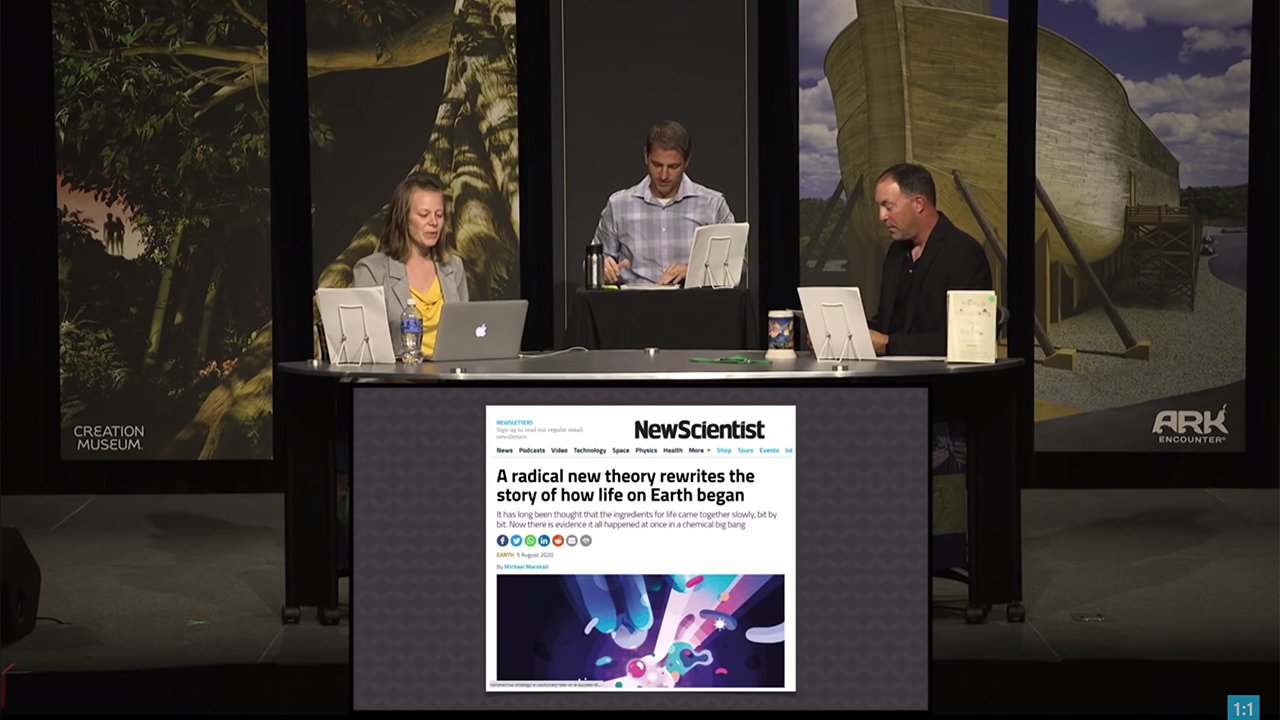
As this article from New Scientist states,

It has long been thought that the ingredients for life came together slowly, bit by bit. Now there is evidence it all happened at once in a chemical big bang.

In other words, it used to be that life evolved so slowly you couldn’t see it happening, and now it happened so fast we missed it!

The article explains that life requires, at the bare minimum, “three core systems”: an outer membrane, the ability to metabolize, and the ability to reproduce using genes. Chemical evolutionists have a problem when it comes to trying to explain the origin of life—you need all three of these systems at the same time for life to even be imaginable. So scientists have argued over which came first, but now some say all three came at the same time. That’s a pretty fortunate set of circumstances!

In other words, it used to be that life evolved so slowly you couldn’t see it happening, and now it happened so fast we missed it!

Geneticist Dr. Georgia Purdom says of this study,

The scientists correctly define what you need for life—something to contain it (membrane), ability to make/utilize energy (metabolism), and ability to reproduce. They’ve given up on bacteria being the first living organism because they know how complex even these “simplest” organisms are. Since none of their other ideas about which came first have panned out, they’ve decided that all three requirements for life must have evolved at once from “Goldilocks chemistry.”

Just like Goldilocks is a fairytale, so is their idea for the origin of life!

So just the right molecules interacting under just the right conditions in just the right place led to a living organism. Just like Goldilocks is a fairytale, so is their idea for the origin of life! All of the research to develop this idea has depended on the scientists adding just the right chemicals (e.g., iron, sulfur) in just the right conditions (e.g., UV light), meaning intelligent design was needed, and they still didn’t end up with anything living! Life only comes from life (the law of biogenesis), and life only comes from the Creator God.

The popular summary of the study concludes with,

Of course, all this depends on the everything-first idea proving correct. Szostak’s protocells and the new biochemical insights have won over many researchers, but some pieces of the puzzle are still missing. Perhaps the most persuasive argument is that the simpler ideas don’t work. As is the case with many things in life, the beginning was probably more complicated than we had thought.

So the strongest support for this origin of life story is this: that the alternatives don’t work? Maybe that’s because life didn’t arise by natural processes! Really, their story is nothing more than a “just-so” story because they have to somehow explain the origin of life without God. They’d rather put their faith in the unbelievable—that something as complex as life could just pop into existence—than put their faith in the One who made them. And not just any “One,” but the only One true God: the Creator God of the Bible.

And information systems don’t just pop into existence. Information only comes from other information and, ultimately, a mind (in this case the mind of the Creator).

Life shows the fingerprints of the Designer. Just consider one of the three categories for life—the ability to reproduce using genes. This requires an information system to code the instructions needed to assemble life. And information systems don’t just pop into existence. Information only comes from other information and, ultimately, a mind (in this case the mind of the Creator).

Just as information only comes from information and, ultimately, a mind, so life only comes from life and, ultimately, the Lifegiver. These researchers, studying the incredible complexity of life, are without excuse for denying the Creator’s existence (Romans 1:20).