Forget Slow-and-Gradual—New Study Says Life “Emerged Fully Formed”

From Answers in Genesis comes this report that scientists are thinking abut creation as a potential explanation for the beginning of life.


Forget Slow-and-Gradual—New Study Says Life “Emerged Fully Formed”

by Ken Ham on August 20, 2020

 
Share: 


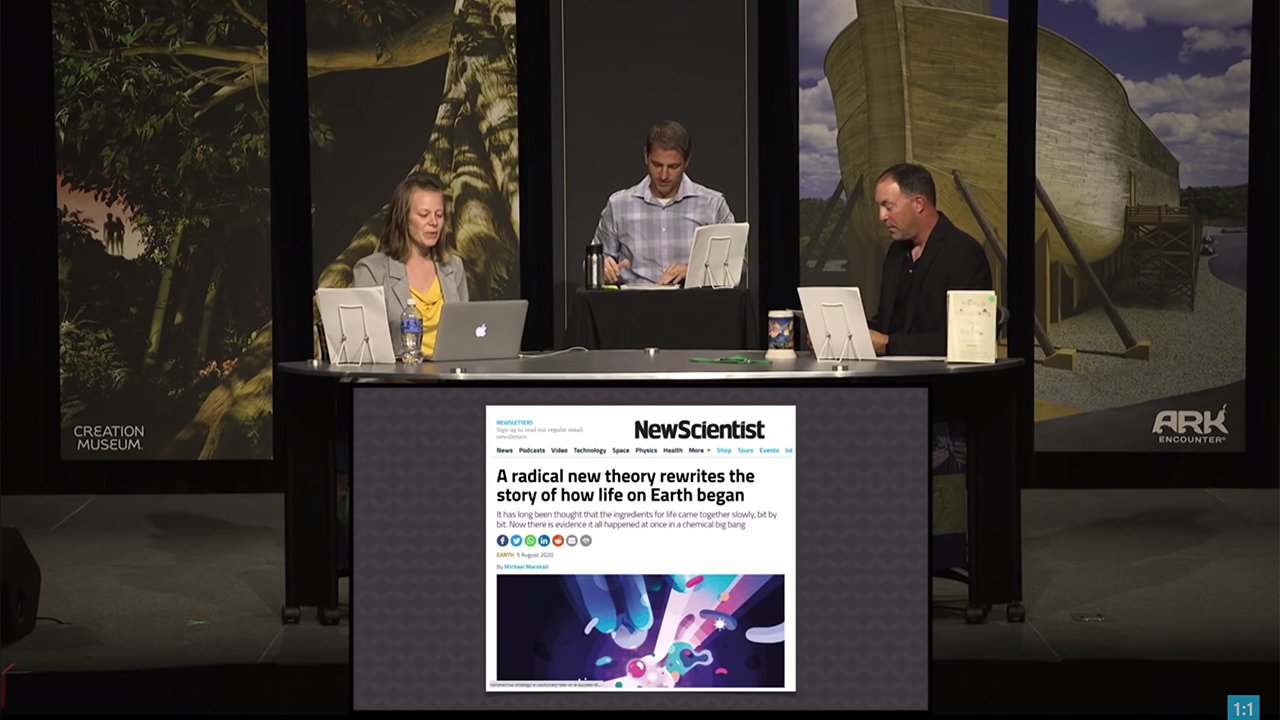
For decades scientists have debated when, how, and where the first life supposedly evolved. Various hypotheses abound: maybe RNA came first; perhaps life evolved around hydrothermal vents; maybe life arrived on an asteroid—but none have satisfied everyone, due to significant problems with each one. And now an old idea has been revived and refined: maybe there was a “chemical big bang,” and life arose spontaneously in a river, with all the major components in place all at once.

As this article from New Scientist states,

It has long been thought that the ingredients for life came together slowly, bit by bit. Now there is evidence it all happened at once in a chemical big bang.

In other words, it used to be that life evolved so slowly you couldn’t see it happening, and now it happened so fast we missed it!

The article explains that life requires, at the bare minimum, “three core systems”: an outer membrane, the ability to metabolize, and the ability to reproduce using genes. Chemical evolutionists have a problem when it comes to trying to explain the origin of life—you need all three of these systems at the same time for life to even be imaginable. So scientists have argued over which came first, but now some say all three came at the same time. That’s a pretty fortunate set of circumstances!

In other words, it used to be that life evolved so slowly you couldn’t see it happening, and now it happened so fast we missed it!

Geneticist Dr. Georgia Purdom says of this study,

The scientists correctly define what you need for life—something to contain it (membrane), ability to make/utilize energy (metabolism), and ability to reproduce. They’ve given up on bacteria being the first living organism because they know how complex even these “simplest” organisms are. Since none of their other ideas about which came first have panned out, they’ve decided that all three requirements for life must have evolved at once from “Goldilocks chemistry.”

Just like Goldilocks is a fairytale, so is their idea for the origin of life!

So just the right molecules interacting under just the right conditions in just the right place led to a living organism. Just like Goldilocks is a fairytale, so is their idea for the origin of life! All of the research to develop this idea has depended on the scientists adding just the right chemicals (e.g., iron, sulfur) in just the right conditions (e.g., UV light), meaning intelligent design was needed, and they still didn’t end up with anything living! Life only comes from life (the law of biogenesis), and life only comes from the Creator God.

The popular summary of the study concludes with,

Of course, all this depends on the everything-first idea proving correct. Szostak’s protocells and the new biochemical insights have won over many researchers, but some pieces of the puzzle are still missing. Perhaps the most persuasive argument is that the simpler ideas don’t work. As is the case with many things in life, the beginning was probably more complicated than we had thought.

So the strongest support for this origin of life story is this: that the alternatives don’t work? Maybe that’s because life didn’t arise by natural processes! Really, their story is nothing more than a “just-so” story because they have to somehow explain the origin of life without God. They’d rather put their faith in the unbelievable—that something as complex as life could just pop into existence—than put their faith in the One who made them. And not just any “One,” but the only One true God: the Creator God of the Bible.

And information systems don’t just pop into existence. Information only comes from other information and, ultimately, a mind (in this case the mind of the Creator).

Life shows the fingerprints of the Designer. Just consider one of the three categories for life—the ability to reproduce using genes. This requires an information system to code the instructions needed to assemble life. And information systems don’t just pop into existence. Information only comes from other information and, ultimately, a mind (in this case the mind of the Creator).

Just as information only comes from information and, ultimately, a mind, so life only comes from life and, ultimately, the Lifegiver. These researchers, studying the incredible complexity of life, are without excuse for denying the Creator’s existence (Romans 1:20).

Volcano produced in 6 months

Some people ridicule creationists for believing in a “Young Earth”, but when geology happens in front of your eyes, then there is a deep flaw in the “deep time” theory.

From wattsupwiththat.com

Birth of an underwater volcano: “This thing was built from zero in 6 months!”… Which is a lot less than 12 years

David Middleton / 1 hour ago May 22, 2019

Guest geological observation by David Middleton

From the American Association for the Advancement of SCIENCE! of America…

Ship spies largest underwater eruption ever
By Roland PeaseMay. 21, 2019 , 1:20 PM


Last week, Marc Chaussidon, director of the Institute of Geophysics in Paris (IPGP), looked at seafloor maps from a recently concluded mission and saw a new mountain. Rising from the Indian Ocean floor between Africa and Madagascar was a giant edifice 800 meters high and 5 kilometers across. In previous maps, there had been nothing. “This thing was built from zero in 6 months!” Chaussidon says.

His team, along with scientists from the French national research agency CNRS and other institutes, had witnessed the birth of a mysterious submarine volcano, the largest such underwater event ever witnessed. “We have never seen anything like this,” says IPGP’s Nathalie Feuillet, leader of an expedition to the site by the research vessel Marion Dufresne, which released its initial results last week.

The quarter-million people living on the French island of Mayotte in the Comoros archipelago knew for months that something was happening. From the middle of last year they felt small earthquakes almost daily, says Laure Fallou, a sociologist with the European-Mediterranean Seismological Centre in Bruyères-le-Châtel, France. People “needed information,” she says. “They were getting very stressed, and were losing sleep.”

[…]

Science! As in “She blinded me with…”

Reflection on Genesis 1:1-2:3

creation

Passage: https://www.biblegateway.com/passage/?search=Genesis+1:1-2:3

Scripture

In the beginning God created the heavens and the earth.

Observation

In the beginning God created. Over six days, God set about forming a bleak and dull universe into something beautiful and capable of sustaining life.

There is a method, a process, of firstly forming the heavens, the water and sky, and the earth, and then filling them.

At the end of the sixth day, God proclaims it is very good, and then sets aside the seventh day as the Sabbath rest.

Application

In the beginning God…

God is at the beginning of creation. Nothing is made without Him. Nothing lasts without Him.

Our lives should be the same- every plan, every thought , every deed should find its beginning in God. It is when we move away from the source of all things that we move towards sin and death.

In the beginning God created…

It is in God’s nature to create, to bring into being things that were not. We are created in God’s image, and therefore we are creators. Every human being has the capacity to create things- art, poetry, movies, buildings, inventions, more people.

When we believe that we are not creative, then we are in bondage to sin- satan has lied to us about our destiny and our purpose.

In my lifetime, I have seen an explosion in wealth around the globe due to creativity. Some of this is in harnessing God’s creation (agriculture and mining), some of it from turning God’s creation into human creation (industry), but much of it is in services where human ingenuity is harnessed, for example in the software that runs our apps and internet services. Financial services multiply wealth when money- intrinsically valueless in itself- generates more money as it is transformed into different states.

Creativity is a blessing from the Lord the creator. It is an exceptional sign of the image of God in human beings.

Of course, due to sin we can corrupt this to destructive and sinful ends. God calls us to build up not pull down and to create not destroy.

Prayer

Lord God, how amazing it is to think that before all things came into being, you were there. How awesome to contemplate that this world, for all its problems, is a product of your design and not a chance arrangement of atoms. Amen.

Nature More Diverse Than We Know

So a scientist thinks that there could be 10 times as many species of plants and animals than we know.  This not only demonstrates the huge creativity of the Creator God, but it also puts the lie to all those ads by such mendacious groups as WWF and their ilk who make claims such as “70% of all animal species have died”- if we don’t even know how many there are now, how can we even guess at such a percentage?

From the ABC

Number of plant and animal species could be 10 times greater, Flinders University professor says

Posted about 2 hours ago

The number of different plant and animal species in the world may be 10 times greater than we think, according to a professor from Flinders University.

An Australian team has written to the journal, Nature, claiming the estimate of 8.7 million species could be just a fraction of the true figure.

Professor Mike Lee, an evolutionary biologist with the South Australian Museum and Flinders University, said it was a “known unknown”.

“Knowing how many different forms of life live on earth is probably one of the most fundamental questions a scientist can ask,” he said.

“Despite 300 years of taxonomy, there’s still vast disagreements and estimates range between 3 million and 100 million.”

Professor Lee said the processes to determine different species used to be quite superficial.

“What we’ve done in the main is look at animals with the naked eye, and sort them into piles, and each pile we think is a new species,” he said.

“But when we look at the piles really, really closely, using genetics, it turns out each pile isn’t really just a homogenous set of individuals.

“They might be very similar, but nonetheless subtly different species.”

Number of species in the world could be up to 90 million

He believes the real number could be closer to 90 million, and that is important for conservation efforts.

“If we thought there was only one African elephant, we might not be concerned that all the elephants in the forest were going extinct, because we might think there’s plenty of the same thing out on the savanna,” Professor Lee said.

“But of course if you know there’s two different species, and the African forest elephant is a unique and irreplaceable genetic and conservation resource, then you’d be really concerned if it’s going extinct.”

Professor Lee said it was not reassuring that there might be more species out there, because they could also be falling extinct without our knowledge.

His letter to Nature was co-written by Paul Oliver from the Australian National University.

Science Says We Shouldn’t Be Here

For all the sophistication of modern science, and believe me I am a big fan of science done well, there is one massive blind spot.

Scientism or naturalism is the belief that science can explain everything without reference to God. There are many problems with that belief, one of which is that science can never really explain why there is anything. In fact science can only tell us that we shouldn’t be here. Yet here we are.

From the ABC:

The antimatter mystery: Annihilation and a universe that shouldn’t exist

Updatedabout an hour ago

Antimatter isn’t just a great plot device for sci-fi stories. It’s at the heart of one of the great mysteries in modern physics — why our universe has stuff in it.

Key points:

  • Equal amounts of matter and antimatter were made in the Big Bang
  • These should have destroyed each other
  • But some how we ended up with left over matter
  • Physicists are looking for the cause of this by smashing high speed particles together

But antimatter isn’t as exotic as it sounds.

Every particle that makes up matter — the electron, proton, neutron and their more-obscure cousins — has an almost-identical twin: its antiparticle.

They were both made together from cooling energy in really high-energy environments like the big bang.

Antiparticles are exactly the same as their particle “siblings”, except they have the opposite charge.

So there’s no way to tell particles and antiparticles apart, except for how they are affected by other charged particles.

An electron (negatively charged) will be attracted to a proton (positive), but an anti-electron (positive charge) will be repelled by it.

Anti-protons, anti-neutrons and anti-electrons can get together to form anti-atoms that act just like regular atoms. And anti-atoms can make anti-molecules that would behave just the same as regular molecules.

There could even be an anti-you that would look, sound and behave just like you do.

The only difference between them and a regular twin would be as soon as you shook anti-you’s hand, you’d both be destroyed in a massive flash of light, as your matter and antimatter converted back to the energy that they formed from.

This same thing happens whenever matching matter and antimatter particles get together — they annihilate each other, converting back to the energy they came from.

Which brings us to a fundamental problem with our understanding of the universe: we shouldn’t be here.

Full article here

The Startling Truth About Water on Mars

There is a lot of excitement in the media today about water being discovered on Mars and its implication for finding life there. Some people seem to think that finding water means we have found life.

Let’s put aside the assumption that life must be common in the universe because it arose “spontaneously” on earth then evolved totally by chance to produce us, and look at the logic being ignored by many people.

Back when I did maths at High School one thing that was emphasised in the more advanced subjects was the difference between “necessary” and “sufficient” conditions in proofs.

For example, apart from the number 2, it is necessary for a number to be odd if it is to be prime. However it is not sufficient to show that a number is odd to prove it is prime.

Another example is it is necessary for a car to have fuel in the tank in order to drive it, but that is not sufficient- you need a driver with the key, air in the tyres, an engine that works, and much more.

Returning to Mars, we know that water is essential for life. This is so axiomatic that the scientists looking for life on other places, make that the starting point in their search. No water no life.

But life requires more than water. It needs carbon, nitrogen, phosphorus and, above all else, energy.

Water is a necessary condition but it is not sufficient.

Some scientists are so pessimistic about the ability of life to spontaneously emerge from the primordial soup that they believe that the existence of life on earth in itself suggests there must be an infinite number of parallel universes to allow for the possibility that on just one planet in one of those universes life arose all by itself.

To me that is grasping at straws. It makes much more sense to believe in a Creator who made everything that is out of nothing. As Genesis 1:1 says “In the beginning God created the heavens and the earth.”

Amazing Numbers of Stone Tools in Africa

Creationists believe that evolution is fundamentally flawed. I tend to agree with them on that, especially on the issue of how life began.

But here is an article that shows that stone agers must have had factories for the mass production of tools if they were to fit into the Young Age timeline.

From godandscience.org

Trillions of Stone Age Artifacts: A Young Earth Anthropology Paradox
by Naturalis Historia

Stone tools galore!

Young earth creationists say that the “Stone Age” in Africa lasted less than 500 years. However, a survey of the African landscape shows that there are 15 to 150 trillion stone tools, requiring hundreds of thousands of years (minimum) to produce. Did God plant all those tools to trick us into believing they had been produced over millennia?

Rich Deem, editor

Introduction

Trillions of stone artifacts cover the surface of the African continent. The product of the manufacturing of stone tools by hunters and gathers over long periods of time, these stone artifacts literally carpet the ground in some places in Egypt and Libya.

Just how much Stone-Age produced rock could be strewn across the African continent?

Imagine a volume of rockequivalent to 42-84 million Great Pyramids of Giza.

The “million” isn’t a typo. That number sounds absolutely fantastic, doesn’t it? Let’s take a look at how these numbers were derived.

PLoS Study

The results of a study just published (seereferencesbelow) shows how incredibly dense stone artifacts can be in some places in Africa. Working in a remote location in southern Libya, researchers took surveys from hundreds of one or two-meter square plots. From the tens of thousands of artifacts found in them, they estimateda minimum density of 250,000 stone artifacts per square kilometeris present in this portion of Libya.

And this only included what was visible on the surface.

Figure C of the supplemental material from ????? PLOSone
Figure C of the supplemental material from the paper by Foley RA, Lahr MM (2015) Lithic Landscapes: Early Human Impact from Stone Tool Production on the Central Saharan Environment. PLoS ONE 10(3): e0116482. doi: 10.1371/journal.pone.0116482. This shows the rocky landscape of southern Libya and the artifacts that are found in high abundance.

The researchers surveyed other published estimates of stone-tool densities in other areas of Africa. For example, some parts of the Nubian Desert average 12 million artifacts per square kilometer. They also calculate expected stone production given certain assumptions about population size and stone tool use over time. Overall, the researchers estimate that stone tool production across the entire continent of Africa has resulted in an average of 500,000 to 5,000,000 artifacts per square kilometer.

Africa is roughly 30 million square kilometers in area, so that would put the total number of stone artifacts between 15 and 150 trillion. Yes, that is trillion with a T—an astounding number.

The authors of this paper turn their estimate of stone production into a volumetric estimate and reach the following equally amazing conclusion:

“Taking the maximum figures, this yields … 2.1 x 10 14 cubic meters of rock. This is the equivalent of 84 million Great Pyramids of Giza… or 42 million taking into account the uneven hominid occupation suggested above. To extend the comparison further, it would be the equivalent of finding between 1.2 and 2.7 Great Pyramids per square kilometer throughout Africa.”Lithic Landscapes: Early Human Impact from Stone Tool Production on the Central Saharan Environment.

A few months ago I wrote (How Rare Are Stone Age Artifacts? A Visit to a Stone Tool-Making Factory in South America) about a dense stone artifact site in South Africa and stated that in just a few acres there had to be billions upon billions of artifacts. As well, in South America alone, there must be hundreds of billions of artifacts.

But this new analysis shows that my estimates were far too conservative.


Full article here

The Amazing Human Heart

The Human heart is an amazing organ. Heather Brinson writes about the engineering challenges you overcome every day just to survive.

To survive, we require a specialized pump that can deliver life-giving blood to all our body parts, day and night, year after year, without fail. To get the job done within the body of a living organism, the heart must overcome some incredible engineering challenges.

Our lives hang on a thread. A constant flow of rich blood must reach cells throughout the body, delivering oxygen and essential nutrients to our extremities, while removing waste products like carbon dioxide. Stop the flow for just a few minutes, and life will cease.

How did the Creator ensure a steady flow? He gave us a pump made of soft flesh, not of hard steel. Estimates vary, but this powerful muscle pushes blood through at least 1,500 miles (2500 km) of blood vessels, some as narrow as one red blood cell. The heart must keep beating 100,000 times a day without tiring or malfunctioning.

We are a walking miracle, exquisitely designed for life on Earth. Just consider three engineering challenges that our heart has to overcome.

Full story here