Creationists believe that evolution is fundamentally flawed. I tend to agree with them on that, especially on the issue of how life began.
But here is an article that shows that stone agers must have had factories for the mass production of tools if they were to fit into the Young Age timeline.
From godandscience.org
Trillions of Stone Age Artifacts: A Young Earth Anthropology Paradox
Introduction
Trillions of stone artifacts cover the surface of the African continent. The product of the manufacturing of stone tools by hunters and gathers over long periods of time, these stone artifacts literally carpet the ground in some places in Egypt and Libya.
Just how much Stone-Age produced rock could be strewn across the African continent?
Imagine a volume of rockequivalent to 42-84 million Great Pyramids of Giza.
The “million” isn’t a typo. That number sounds absolutely fantastic, doesn’t it? Let’s take a look at how these numbers were derived.
PLoS Study
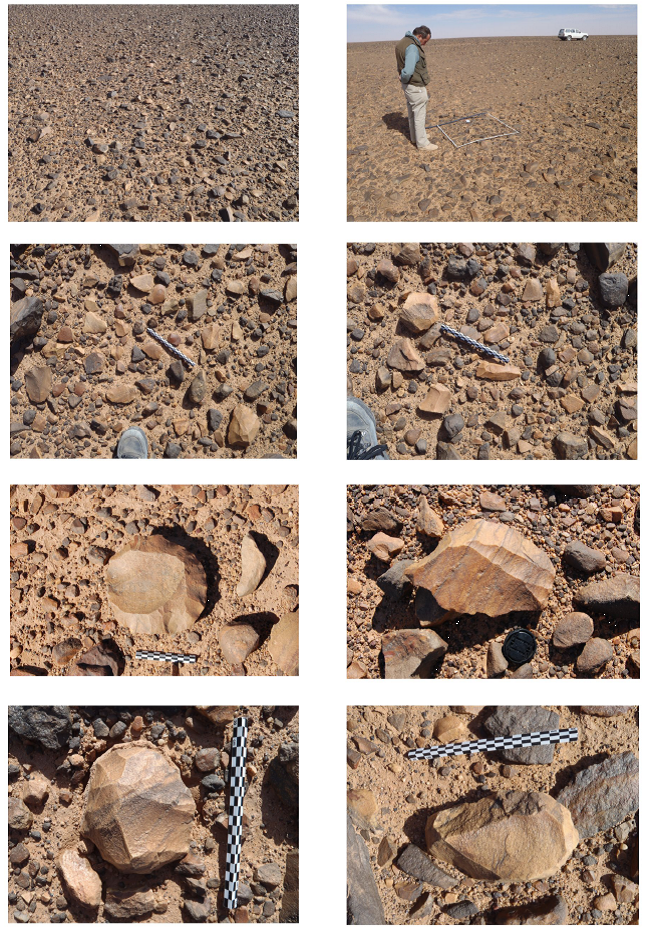
The results of a study just published (seereferencesbelow) shows how incredibly dense stone artifacts can be in some places in Africa. Working in a remote location in southern Libya, researchers took surveys from hundreds of one or two-meter square plots. From the tens of thousands of artifacts found in them, they estimateda minimum density of 250,000 stone artifacts per square kilometeris present in this portion of Libya.
And this only included what was visible on the surface.
Figure C of the supplemental material from the paper by Foley RA, Lahr MM (2015) Lithic Landscapes: Early Human Impact from Stone Tool Production on the Central Saharan Environment. PLoS ONE 10(3): e0116482. doi: 10.1371/journal.pone.0116482. This shows the rocky landscape of southern Libya and the artifacts that are found in high abundance.The researchers surveyed other published estimates of stone-tool densities in other areas of Africa. For example, some parts of the Nubian Desert average 12 million artifacts per square kilometer. They also calculate expected stone production given certain assumptions about population size and stone tool use over time. Overall, the researchers estimate that stone tool production across the entire continent of Africa has resulted in an average of 500,000 to 5,000,000 artifacts per square kilometer.
Africa is roughly 30 million square kilometers in area, so that would put the total number of stone artifacts between 15 and 150 trillion. Yes, that is trillion with a T—an astounding number.
The authors of this paper turn their estimate of stone production into a volumetric estimate and reach the following equally amazing conclusion:
“Taking the maximum figures, this yields … 2.1 x 10 14 cubic meters of rock. This is the equivalent of 84 million Great Pyramids of Giza… or 42 million taking into account the uneven hominid occupation suggested above. To extend the comparison further, it would be the equivalent of finding between 1.2 and 2.7 Great Pyramids per square kilometer throughout Africa.”Lithic Landscapes: Early Human Impact from Stone Tool Production on the Central Saharan Environment.
A few months ago I wrote (How Rare Are Stone Age Artifacts? A Visit to a Stone Tool-Making Factory in South America) about a dense stone artifact site in South Africa and stated that in just a few acres there had to be billions upon billions of artifacts. As well, in South America alone, there must be hundreds of billions of artifacts.
But this new analysis shows that my estimates were far too conservative.

Full article here


