From Canberra Declaration
Among the recommendations the Index puts forward is an Australian Freedoms Act that would provide enforceable nationwide protections for speech, religion, conscience and association.
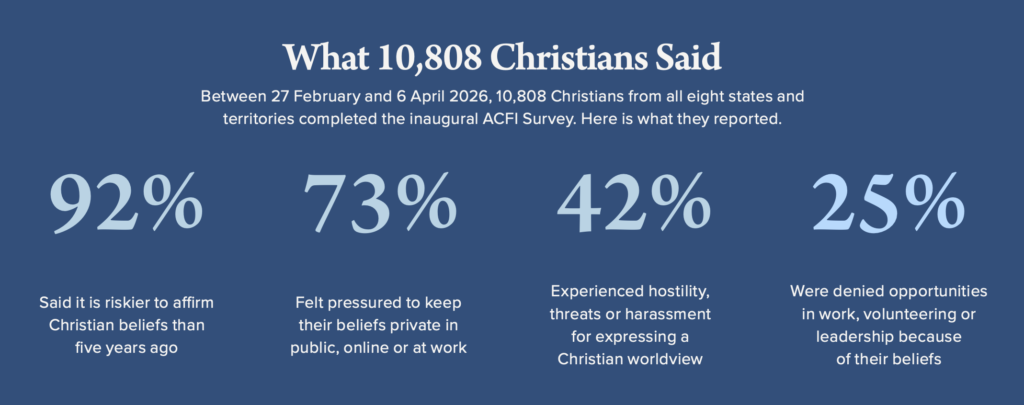
Australia’s first systematic audit of Christian freedom launches at Parliament House in Canberra tomorrow morning, with preview data already showing that nine in ten Australian Christians believe it has become riskier to affirm their faith publicly than it was just five years ago.
The Australian Christian Freedom Index (ACFI) 2025 — a 108-page report produced by the Canberra Declaration in partnership with the Australian Christian Lobby, FamilyVoice Australia, the Australian Family Coalition, CitizenGo, and the Human Rights Law Alliance — will be released at a bipartisan breakfast in the Reps Alcove at 7am on Thursday 28 May.
The event will be livestreamed at the link below.
Representatives from the Labor, Liberal and National parties, along with One Nation, are expected at the event, with organisers around a dozen parliamentarians.
Seven of the report’s eleven authors will give a short speech at the launch event. Every attendee will receive a hand-signed copy of the report.
What the Report Will Show
A companion guide released ahead of tomorrow’s launch — available here — previews the report’s major findings.
The full data draws on 10,808 survey responses collected from Christians across every Australian state and territory between 27 February and 6 April this year.
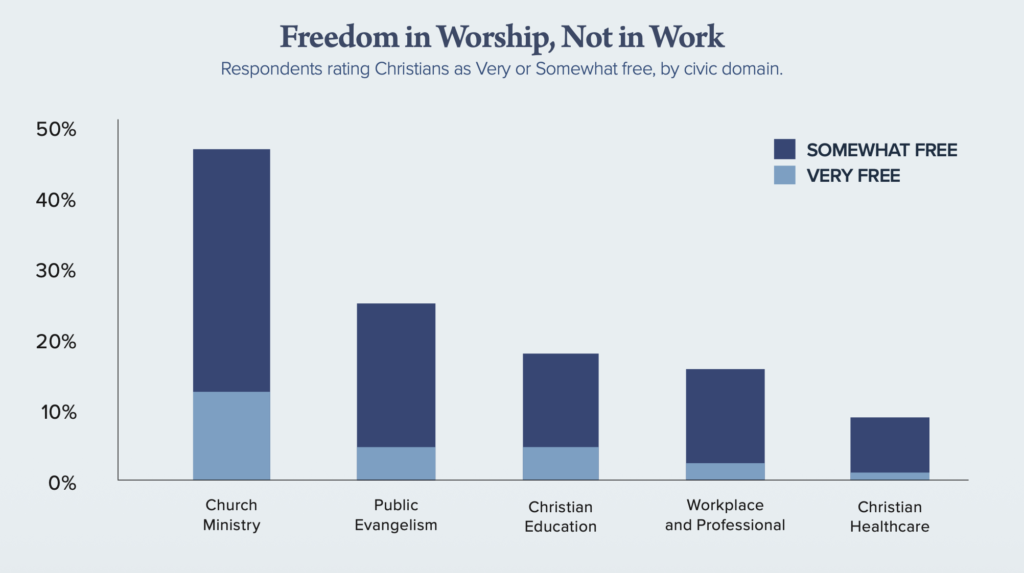
The companion guide shows perceptions of freedom varying sharply by civic domain. Respondents rated Christians as most free in church ministry and worship — the only domain where close to half rated Christians as at least somewhat free.
That figure fell to roughly one in four for evangelism, and dropped even further for Christian education and the workplace.
The lowest result was for Christian healthcare, where just 8% of respondents rated Christians as somewhat or very free to operate according to their beliefs.
The report’s legislative audit, which covers 74 Acts across nine jurisdictions from 2000 to 2025, documents a sharp acceleration in restrictive legislation.
Victoria ranks as the most legislatively restrictive jurisdiction; Western Australia the least.
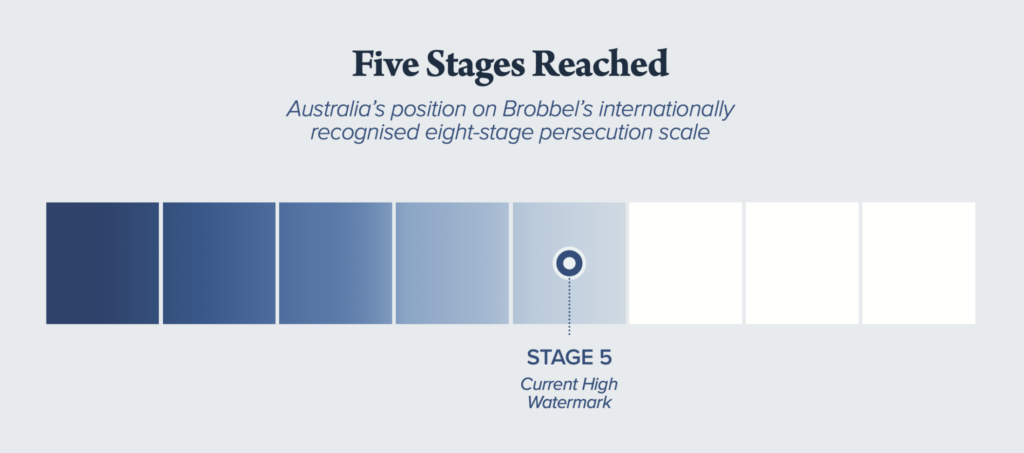
Using the eight-stage persecution scale developed by Floyd A. Brobbel of Voice of the Martyrs Canada — a scale that runs from ridicule through harassment, discrimination, defamation and attack, to detainment, torture, and martyrdom — the ACFI locates Australia’s documented cases across the first five stages.
42 Recommendations
The report does more than document the problem: it makes 42 concrete recommendations across three audiences: parliaments, church leaders, and individual Christians.
For parliaments, the ACFI calls for an Australian Freedoms Act that would provide enforceable nationwide protections for speech, religion, conscience, and association — a positive legislative right to replace what it describes as the current patchwork of exemptions.
It also calls for restored religious hiring exemptions for faith-based schools across all jurisdictions and an end to compelled participation in abortion and assisted suicide for healthcare workers with conscientious objections.
For church leaders, the report urges public advocacy for Christians facing legal pressure, stating plainly that silence has only increased hostility.
The index also calls for the establishment of a national register of anti-Christian incidents, a mechanism that does not currently exist in Australia.
For individual Christians, the report calls on believers to maintain their public witness, engage their elected representatives, and share the findings of the report.
Most Australians — including most Christians — remain unaware of the scale of what the report documents, the companion guide notes.

