The Downside of Net Zero In 100% Green Canberra

From Jo Nova:

In “100%” Renewable Canberra people are queuing to hang out in warm libraries, and the air is more polluted

Kill trees, pollute the air, punish the poor and protect coal underground

Just another day in Green heaven.
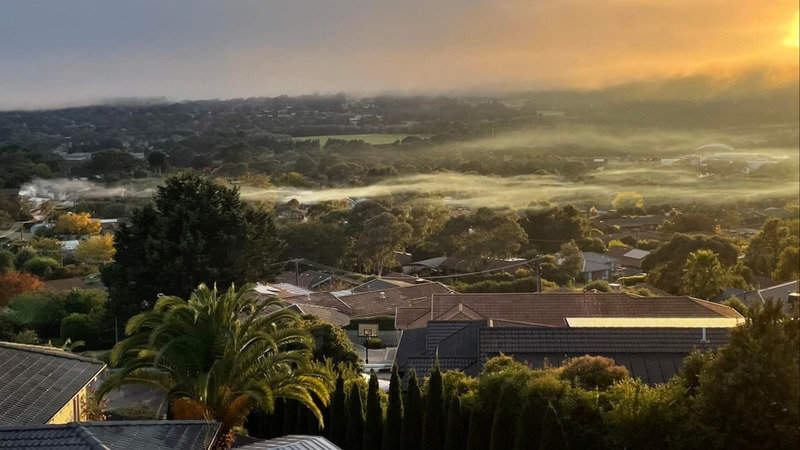
Canberra Wood Smoke

Wood smoke over Canberra   |   Photo from Clean Air Canberra

The Australian capital city Canberra in midwinter is often minus 1 to 5 degrees C in the morning. Australian homes can get very cold and with heating bills rocketing, things are defacto becoming like life in Berlin, which is in a pre-War energy crisis. No one labeled Canberra public halls as “warm spaces” and they definitely aren’t open at night (it’s the public service!), but crowds are arriving at libraries just to escape the cold.

The ACT Government are a Labor-Green alliance, and are proudly, exuberantly “100% Renewable”, but won’t dare cut the cord to the coal plants that keep the lights on, making the claims of being 100% renewable a form of 100% false advertising. Even the ABC admits that the ACT itself only generates 5% of its own power, and 80% of the energy coming to the ACT through the wires is from fossil fuels. They pay off some distant wind farms to balance the theoretical gigawatt-hour tallies, and sponge off the states around for cheaper backup and stability that the coal plants provide.

But as electricity prices rises 14% of Canberran’s are heating their homes with wood. This has predictably increased actual air pollution. So now there is a movement to ban wood fires.

If only there was a 300 year supply of cheap fuel to burn at centralized clean power stations…

Like all Green policies putting fashion before facts, they get the opposite of what they aim for.

FLAT WHITE

Canberra: where electricity is a luxury the poor can’t afford

Tina Faulk, The Spectator

Public libraries in the National Capital are now considered, by staff and patrons alike, to be ‘community centres’ where people come to read, use the computers, charge their phones, and use the toilets. It’s where clients of the NDIS, escorted by carers, are brought and propped up in their wheelchairs in front of computers or seated in deep armchairs by the magazine stands. Some, abandoned by their carers, shout incoherently for attention. Newly arrived migrants – Somalis, Iraqis, Syrians – jostle for attention of the library staff, asking for translation assistance with various forms and declarations.

Our libraries, warm and welcoming, have a crowd at their doors before the 10 am opening.

Groups of women discuss where they go to get warm:

One [woman] who recently ‘VR-ed’ (Voluntary Retired) still goes back to her old workplace, usually late morning, when the security guard who remembers her gives a nod and a smile as she settles into one of the comfortable settees in the reception area.

How sad is that — going back to her old workplace foyer just to stay warm?

Wood heaters in the firing line as temps drop and pollution rises

Lottie Twyford, Riotact

A recent report showed woodfire heater smoke is the largest source of winter air pollution in Canberra. Currently, around 14 per cent of people in the ACT use a woodfire heater as their main source of heating.

Analysis of air quality shows the impacts of smoke are worse down south because the shape of the valley and temperature inversions hold pollutants closer to the ground. In 2020, there were 37 days in Tuggeranong when pollution levels were above acceptable levels; of those, 13 can be attributed to woodfire heater emissions, Mr Davis told the ACT Legislative Assembly.

The local newspaper is running stories about the “right temperature” to heat homes to. They suggest 18°C (colder than the public buildings in Germany which are now set down to 20°C). A few years ago I stayed with a friend in Canberra and the room was 11°C (and it was only May!).

Read the full article here

And what happens when that renewable drought is 1 terawatt hour?

From Jo Nova and Matt Canavan


And what happens when that renewable drought is 1 terawatt hour?

Australia has added more unreliable wind and solar than anywhere on Earth but when an energy crisis strikes, and those prices are still on fire, the solution is more of the same.

Senator Matt Canavan, The Australian

Map, Australia, Victoria, Vic.

As rest of the world wakes up on coal, we’re closing it down

Perhaps Australia’s broken electricity system is due to this mad rush towards renewable energy? No, according to our energy regulator, “Recent international events and Australian market events have further strengthened the case for the shift to renewables.”

The renewable energy investments must continue until morale improves.

[The energy regulator’s] recent analysis shows that Victoria could experience a “renewable drought” of 1 terawatt hour of electricity over just one week in the future.

How much is 1TWh? Well, the South Australian big battery can produce 130 megawatt hours, so we would need more than 7500 of these to keep the Victorian lights on. At about $100m a pop, that is a total cost of more than $700bn, or more than Victoria’s total annual economic output.

This winter’s energy shortfalls came just after the Liddell coal-fired power station in NSW’s Hunter Valley shut a 400MW unit in April. Its other three units (a total of 1200MW) will shut next April. Then, in 2025, Australia’s largest coal-fired power station, Eraring, also in the Hunter, is due to shut.

By the end of the decade, our energy regulators warn, almost two-thirds of our coal-fired power could shut.

And Victoria is just one state.

Indeed, across the world there are 345 new coal-fired power stations being built. What is the argument against Australia building just a few to guarantee our energy supplies?

A new ultra-supercritical coal-fired power station built in Australia would increase our emissions by about five million tonnes a year. That would mean global emissions would go up by 0.014 per cent. The world has warmed around 1C after 600 billion tonnes of emissions. So this new coal-fired power station may increase the temperature by 0.0001 of a degree over its life.

Yet we are told a new coal-fired power station would worsen climate change and create more bushfires, floods and all manner of other natural disasters. These arguments are nonsensical yet go unchallenged in polite society.

Matt Canavan is a Liberal National Party senator for Queensland and deputy leader of the Nationals in the Senate.

The Energy Crisis

Australia is now reaping the fruit of the Green madness, and will continue to do so for at least the next decade, or longer if we pursue the Net Zero madness.

Last night, NSW was warned about a potential power shortage from 6 pm to 8 pm. Rolling blackouts were a possibility, we were told.

We dodged the proverbial bullet last night, but it could be on again tonight. If not tonight, then maybe next week. We are only two weeks into winter, and this is where we have got to. Then there is the next peak season, called summer.

The solution to this situation, we are told is more solar and wind power. Solar power will not make a scrap of difference in the evening peak in winter, because it is dark. Here in Narrabri for the last few days it has been very calm, so not much wind power either.

For the last 20 years, successive Governments have been telling us that we have to move away from “fossil fuels” for our power generation. The result is that generator companies have taken the hint and not invested in maintaining or upgrading their facilities. So, over the next few years, coal-powered electricity will virtually disappear from Australia. Ironic, when we have so much “clean” coal in this country that we are sending overseas.

At the same time, the same Governments have been telling us that gas is a good “transition” power source. It is true that gas generators are more responsive to demand and gas produces more energy per tonne of CO2 emitted. But, these Governments have also prevented the gas companies from extracting coal seam gas from most of the country.

So at the time when we most need natural gas as a backup for our electricity grid, there is a huge shortage because of Government policies. The world price of natural gas is high because of the Russia- Ukraine war, and we have lakes of it underground just waiting to be tapped.

Now we have this crazy situation where the electricity regulator has imposed a price cap on wholesale electricity of $300/MW hr (The price used to be about $30, that is how bad things have got). At this price natural gas power generators cannot make a profit, so they don’t want to operate. We have a couple of coal-fired generators under maintenance that was delayed, because there is no point in spending too much on them when they will close in a couple of years anyway.

This is where following the policies demanded by green activists gets you to. The next few years are going to be worse as we close down coal. When electric cars become a significant part of the vehicle fleet, the demand for electricity will be double what it is now.

It is actually worse than that, when you consider how people live. You get home from work, what do you do? Plug your car in, turn the heater or air conditioner on (full blast at first because you’ve been out all day), put the kettle on, then turn on the stove to cook dinner.

That time from 6 pm to 8 pm, when the sun has gone down and the wind is usually calm will for ever be a tight wire act for our power system.

Welcome to our brave new future of Net Zero.

The Globe Refuses to warm

From wattsupwiththat.com

The new Pause lengthens: now 7 years 6 months

By Christopher Monckton of Brenchley

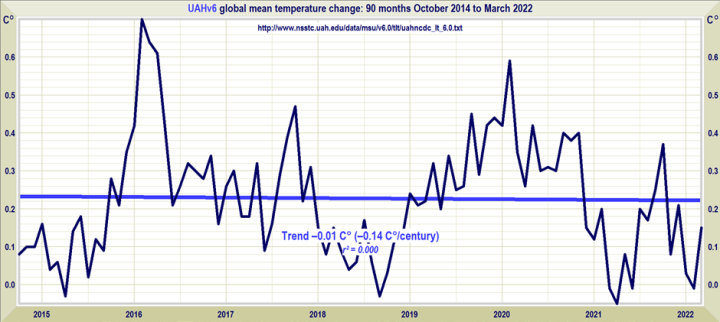
The new Pause has lengthened by another month. On the UAH satellite monthly global mean lower-troposphere temperature dataset, seven and a half years have passed since there was any trend in global warming at all. As always, if anyone has seen this surely not uninteresting fact mentioned in the Marxstream news media, let us know in comments. One of the best-kept secrets in what passes for “journalism” these days is that global temperature has not been rising steadily (or, since October 2014, at all). It has been rising in occasional spurts in response to natural events such as the great Pacific shift of 1976 and the subsequent strong el Niño events, rather than at the somewhat steadier rate that one might expect if our continuing – and continuous – sins of emission were the primary culprit.

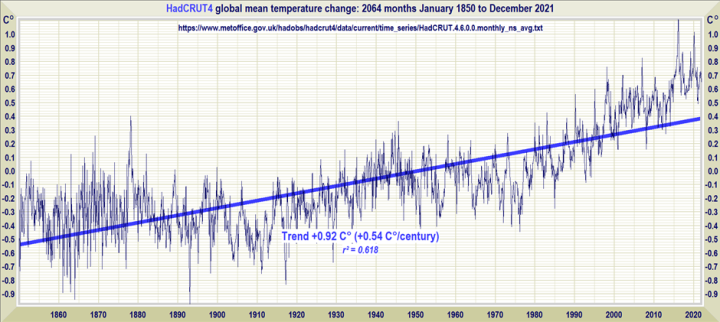
To forestall the usual whingeing about “cherry-picking” from the climate-fanatical trolls, here is the entire HadCRUT4 record of monthly global mean surface temperature anomalies for the 172 years 1850-2021. The trend is a not particularly catastrophic half a degree per century equivalent. Oo-er! Stap me vitals!

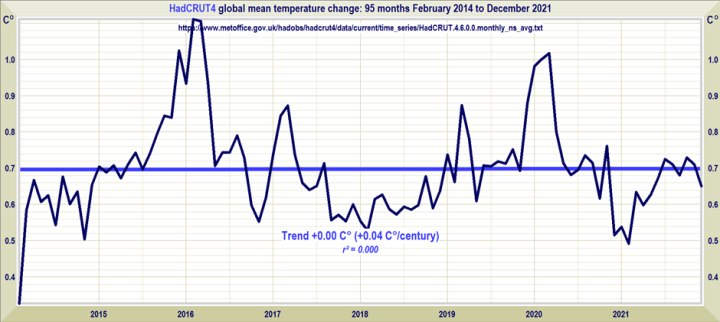
The HadCRUT4 dataset, now at last updated to the end of 2021, shows no global warming for almost eight years:

The significance of these long Pauses should not be underestimated. IPCC (1990, p. xxiv) confidently predicted 1.8 K global mean anthropogenic warming from 1850-2030. Of this, 0.5 K (HadCRUT5: Morice et al. 2021) had occurred by 1990, so that the projection was equivalent to 1.3 K over the four decades 1991-2030, or 0.34 K decade–1. However, observed warming from January 1991 to December 2021 as the mean of the monthly UAH lower-troposphere and HadCRUT4 surface monthly global mean surface temperature anomalies, was 0.5 K, or 0.18 K decade–1. Even if all warming since 1990 was anthropogenic (which it was not), IPCC’s finger-in-the-air prediction has proven to be almost twice outturn.

Meanwhile, soi-disant “leaders” on both sides of the Atlantic, having half-wittedly committed themselves to the Party Line on climate so sedulously peddled for so long by the Desinformatsiya directorate of the KGB (now FSB) and by the many Chinese agents of influence (such as the “Confucius Institutes” at many Western universities), dare not lose face. They cannot bring themselves to admit that they have been wrong, that they have been fooled, and that they have needlessly and expensively ended the free market in energy supply. They cannot brin themselves to change their catastrophic and unaffordable energy policies, even in the face of the fact that it was their eagerness to suppress competition from coal-fired power-stations in the name of Saving The Planet that was the chief source of funding for Vlad the Invader’s special military massacre in Ukraine.

Read the rest of the article here

Great News About Climate Litigation

From the IPA:

IPA TODAY

Federal Court Decision A Welcome Move Against Climate Litigation

Written by Morgan Begg

15 March 2022

The Institute of Public Affairs has today welcomed the Federal Court of Australia’s finding that the federal Minister for Environment does not owe a duty of care to protect Australian children from climate change.

“Today’s decision was a long overdue display of common sense from Australian courts,” said Morgan Begg, the Director of the Legal Rights Program at the Institute of Public Affairs.

“The Australian courts should never have entertained the farcical attempt to prohibit mining and energy projects through the judicial backdoor.”

“The Full Court of the Federal Court today unanimously overturned a May 2021 Federal Court decision that found the federal Minister for Environment, when deciding whether or not to grant approval to a coal mine development, owed a duty of care to Australians under the age of 18 to avoid causing them personal injury as a consequence of increased carbon dioxide emissions.”

“The Justices were putting it lightly when they said the duty would have been “incoherent and inconsistent” under the legislation.”

“It would also be incoherent and inconsistent with a system where decisions about economic development and energy security are made as part of a democratic process,” said Mr Begg.

Morgan Begg

Morgan Begg is the Director, Legal Rights Program at the Institute of Public Affairs

Jo Nova: There were Bigger Floods and Rain-bombs in the 1800’s

Jo Nova writes:

If only the $3 million dollar a day ABC could afford a science team that could do as much research as one unpaid volunteer does in a day?

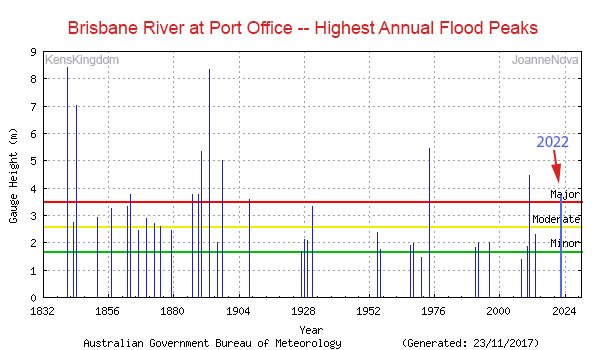
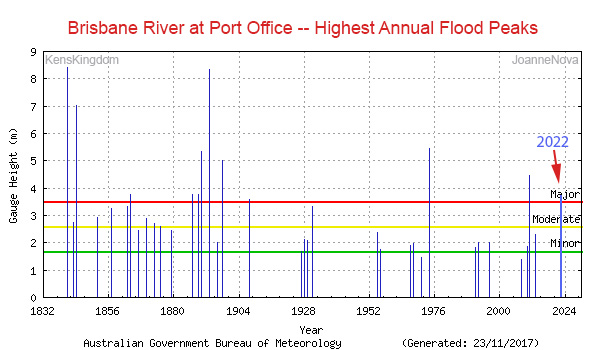
Thanks to Cliff Ollier and Ken Stewart for the BOM graph of past Brisbane Floods. Clearly things were worse in the 1800s.

If CO2 has any effect perhaps it reduces flooding?

There have always been big floods in Brisbane       | BOM Source   |  KensKingdom

One day when the ABC finally gets the Internet they’ll be able to find official pages like “Known Floods in the Brisbane and Bremer River Basin“. And one day the half billion dollar BOM agency will be able to update graphs like this within a week of a new flood peak, like bloggers did (above).

Ken Stewart went looking for lost Rain Bombs and found them

As Ken reports the ABC made a fuss over three Queensland sites recording more than 1 metre of rain in just four days. But neither the ABC or the BOM is telling Australians that there have been at least nine similar “Rain Bombs” before and most of them were more than one hundred years ago.

I went looking at Climate Data Online for four day rainfall totals over one metre, to compare with the recent totals above at Mount Glorious, Pomona, and Bracken Ridge. For a start, Pomona’s BOM station has been closed for years, and Bracken Ridge is not listed at all, so those reports are from rain gauges external to the BOM network and can’t be checked.  That’s OK.  In about half an hour I found the following four day rainfall records.

Crohamhurst4/2/18931963.6mm
Yandina3/2/18931597.8mm
Tully Sugar Mill13/02/19271421.3mm
Palmwoods4/2/18931244.6mm
Buderim3/2/18931150.3mm
Bloomsbury20/01/19701141.8mm
Dalrymple Heights6/04/19891141mm
Innisfail3/04/19111075.8mm
Nambour11/1/18981013mm

1893 was a wet year!  Crohamhurst had 2023.8 in five days, and Brisbane had three floods in two weeks in February and another in June.

And there is no such thing as a “rain bomb”, a term invented to make it sound unprecedented.  This was an entirely natural and normal rain event.  Slow moving tropical lows drift south every few years in the wet season, producing a large proportion of Queensland’s average rainfall.

It’s another Red pill moment. Spread the news. Australians need to know the media and the BOM are not giving them the whole truth. Has anyone in the BOM called up the ABC and corrected their mistake? Isn’t that their job?

The Green Industrial Revolution Is A Lie

As we gear up for a Federal election in May, you can be sure that Labor and the Greens will peddle the fantasy about “Green Jobs”. It is a lie, like the one about renewable energy being cheaper than coal, not to mention the whole climate change scam.

Ben Pile writes on spiked:

The green industrial revolution is a lie

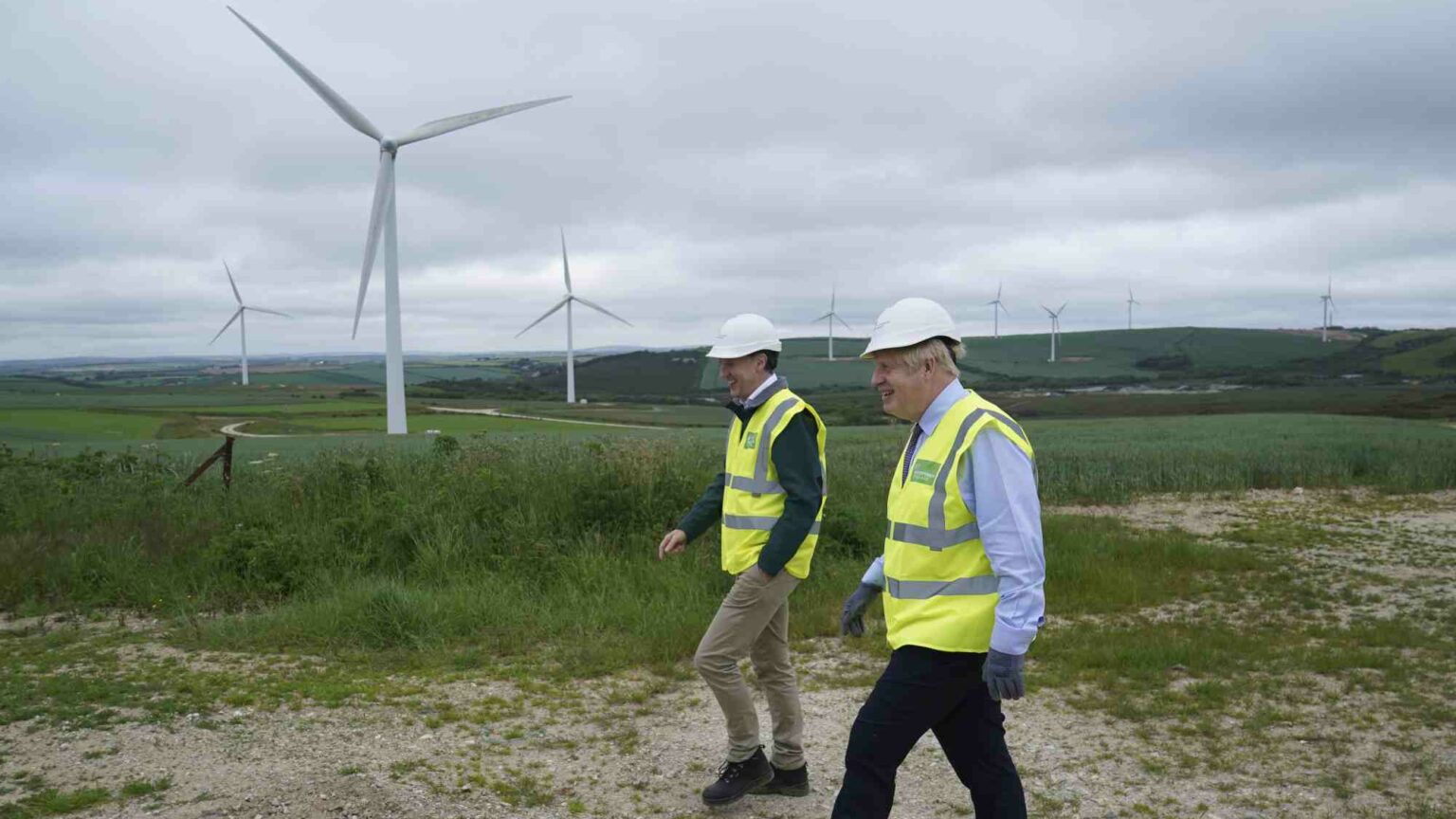
The UK’s green sector has not grown in nearly a decade.

The green industrial revolution is a lie

Share

TopicsPOLITICSSCIENCE & TECHUK

The Office for National Statistics (ONS) published data earlier this month which showed that the UK’s ‘low-carbon and renewable-energy economy’ (LCREE) had not grown significantly between 2014 and 2020. This performance is a far cry from the promises of plentiful ‘green jobs’ and a ‘green industrial revolution’ that have echoed around Westminster for the past decade and more. It turns out that the much heralded green growth was nothing more than mould.

This news should surprise no one. As I have argued elsewhere on spiked, the green industrial revolution is a lie. Since the 2008 Climate Change Act, successive governments have embraced the fantasy of leading the world in the ‘transition’ to a low-carbon economy. And it’s all been to no avail. The rest of the world continues to increase its consumption of fossil fuels despite endless COP meetings, and Britain’s green industrial revolution stubbornly fails to materialise.

Back in 2009, the then Labour government, led by Gordon Brown, claimed the green economy was already thriving. He promised to add 400,000 new ‘green jobs’, taking the total number of people working in the green sector to 1.3million. These claims were based on proprietary data produced by an economic research company, which refused to share its data, as did the government even after freedom-of-information requests.

Even without access to the data, I was already able to point out in 2009 that growth in the ‘green economy’ is an illusion – or better still, an accountancy trick. The government was effectively compelling sectors of the economy, through a variety of green regulations, to ‘decarbonise’ their operations. It was then adding said sectors to the green economy and so the green economy appeared to be growing. This was happening even when the sectors in question had been harmed and diminished by the new regulations.

It took me until 2013 to obtain the data on which successive governments were basing their figures, policies and predictions. By then, it was being claimed that the ‘green economy’ was worth £122 billion. But it had only reached this size because the figure included sectors of the economy that simply do not qualify as ‘green’ in any meaningful sense. It even included the production, transportation and sale of liquefied natural gas and liquefied petroleum gas – otherwise known as fossil fuels – merely because such businesses were now subject to environmental regulation. My analysis at the time suggested that through such tricks, the government’s financial wizards had inflated the value of the ‘green economy’ by something in the region of 700 per cent.

Read the full article here
Giant Reef Discovered Near Tahiti

Australian media seem to have been silent about the discovery of a giant pristine reef near Tahiti, apparently untouched by “climate change.” Makes you wonder how it has coped without UNESCO World Heritage listing or environmental worriers trying to “protect” it.

From Canada’s CBC:

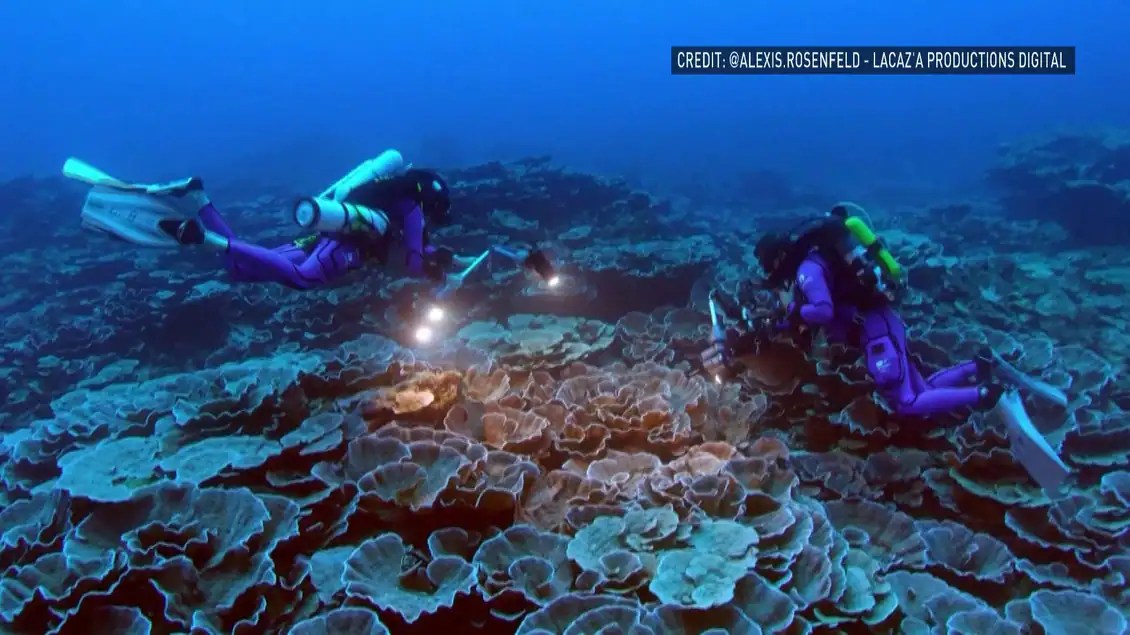
Scientists have discovered a pristine, three-kilometre-long reef of giant rose-shaped corals off the coast of Tahiti, in waters of the southern Pacific Ocean thought to be deep enough to protect it from the bleaching effects of the warming ocean.

The reef, which lies at depths of more than 30 metres, probably took around 25 years to grow. Some of the rose-shaped corals measure more than two metres in diameter.

“It was magical to witness giant, beautiful rose corals, which stretch for as far as the eye can see. It was like a work of art,” said French photographer Alexis Rosenfeld, who led the team of international divers that made the discovery.

Most of the world’s known coral reefs are in warmer waters at depths of up to 25 metres, the United Nations Educational, Scientific and Cultural Organization (UNESCO) said. The reef off Tahiti lies in the “twilight zone” 30 to 120 metres below the surface where there is still enough light for coral to grow and reproduce.

UNESCO says the newly discovered reef is one of the largest in the world.

Bleaching is a stress response by overheated corals during heat waves. They lose their colour, and many struggle to survive.

Perhaps the most famous — Australia’s Great Barrier Reef, a World Heritage-listed wonder — has suffered severe bleaching to an estimated 80 per cent of its corals since 2016.

The discovery off Tahiti’s shores suggests there may be many more unknown large reefs in our oceans, given that only about 20 per cent of the entire seabed is mapped, according to UNESCO scientists.

“It also raises questions about how coral reefs become more resilient to climate change,” UNESCO’s head of marine policy, Julian Barbiere, told Reuters.

More of the ocean floor needs to be mapped to better safeguard marine biodiversity, Barbiere said.

“We know more about the surface of the moon or the surface of Mars than the deeper part of the ocean.”

The BOM Adjusts Historical Data to Make the Warming Look Warmer

If you have to prop up a scientific theory by changing historical records in an unscientific way, and still claim to be doing “science” then you are having yourself on and the rest of the nation. This is the problem when taxpayer funded bodies do science for the activists.

from Jo Nova

The Bureau of Meteorology finds Australia is still getting colder a century later

Surprisingly, the World War I era temperatures are still changing. Mornings that seemed nippy at the time are now susceptible to frosts.

Someone should warn the farmers — except they’re all dead.

Thanks to Chris Gillham for independently and laboriously going through the new unannounced changes in another cycle of BOM’s hidden revamp of Australia’s history. ACORN 2.2 is the latest version of the Australian Climate Observation Reference Network of “the best” 112 weather stations across Australia.

Bureau of Meteorology ‘cools the past, warms present’

Graham Lloyd, The Australian

“The bureau has now remodelled the national temperature ­dataset three times in just nine years,” Dr Jennifer Marohasy said.

In the last five years the ACORN re-revisions by the BOM have discovered another quarter of a degree of warming that we didn’t know about from the last hundred years. It’s not clear why the BOM doesn’t want to tell the world how good they are at correcting thermometer records from 1913.  It seems like a remarkable skill.

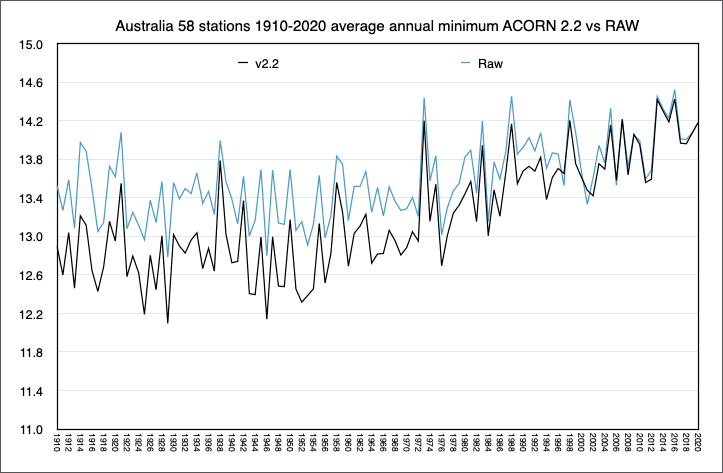
The minima just keep getting cooler

Chris Gillham plots the longest running stations from the ACORN 2.2 set against the old raw readings:Chris Gillham, ACORN 2.2 versus Raw Temperatures

Who knew all those old thermometers were so wrong?

Graham Lloyd:

Independent analysis of the latest changes show they added 0.06C to maximum warming and 0.11C to minimum warming from 1910-19 to 2010-19.

A series of updates to the ACORN data have added 0.228C mean temperature warming if comparing 1910-19 with 2010-17 (2017 being the final year of ACORN 1)

Clearly, the cheapest way to stop global warming would be to sack everyone at the BOM.

The Bureau admitted to Lloyd that they changed 25 sites in the latest round, most of them because of statistical revelations:

The bureau said changes were made to 20 sites on the basis of statistical analysis. According to the bureau, statistical analysis is used to identify an abrupt warming or cooling at a particular site, relative to other sites in the region.

The BOM refuses to tell us exactly how they do this — admitting that they can’t train anyone outside their sacred guild. Which reminds us of the old axiom, “if it can’t be replicated, it isn’t science”.

Apparently the future of life on Earth depends on their data, but it would take too long to train someone outside BOM to check it. Tell us again, how much does climate change matter?

Here’s the BOM explanation of the need for adjustments:

“A significant change relative to other sites indicates a non-­climatic driver, which sometimes has an easily identifiable cause (e.g. a new building near a site) and sometimes does not (often these will relate to local vegetation or land surface changes)”, the bureau said. “In carrying out this statistical analysis, the bureau uses 10 years’ worth of data from multiple sites to quantify the size of the change. Adjustments are only applied where a significant change has been identified.

So instead of researching the site history as deeply as they can, the BOM use statistical trickery analysis to figure out local site changes using some other thermometers “within a thousand miles”. What they don’t do is full historical research and documentation of the sites first. (Like the ones herehere and here, thanks Bill Johnston). So it’s possible that if, say, 10 sites got similar changes at the same time (like changing to a new small screen) the other better sites in non-changing screens could be slowly “corrected” one-by-one by the junkier sites with the right statistical algorithm. Now, perhaps the BOM have ways to make sure that doesn’t happen — but they won’t tell us what they are, they don’t publish the detailed documentation of either the full site histories or the methods they use to correct them.

As Chris Gillham notes, the BOM say the new adjustments didn’t change the long term trend. But a lot of little changes in the same direction would. The new adjustments might have also made a few local hottest ever headlines much easier to get. Suddenly the modern contenders for the longest heatwave, warmest night, and hottest summer all got a head-start.

The mysterious process of homogenization

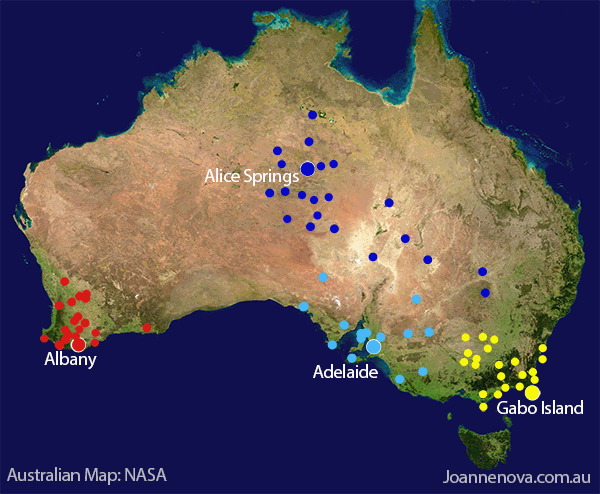
The Bureau “homogenizes” a site according to a mystical method that uses an inexplicable group of sites that are in the same region, or at least in Australia somewhere. For example, lighthouse readings off the Bass Strait have been corrected with help from Hay, 600 kilometers away, on the other side of the Great Dividing Range. A thermometer in Ballarat has been used to correct one at Bruny Island off the South coast of Tasmania.  The BOM has also corrected Alice Springs using measurements in Collarenabri nearly 1,600 kilometers away. (Thanks to Ken Stewart for that tip). When I said “a thousand miles” I wasn’t joking.Australian BOM, Bureau of Meteorology, homogenisation of sites. Map.

All the sites marked in black, for example, have been used to homogenize Alice Springs